

Sunday, May 10, 2009
Carnival of Space #102 @ The Spacewriter's Ramblings


Friday, May 8, 2009
David Dunlap Observatory slated to reopen in the IYA2009!
Congratulations to the folks at the Royal Astronomical Society of Canada!
For more read the RASC news item.
No word on any potential research.
Related Articles
Saturday, May 2, 2009
Space badge resource for Girls and Boys
(See what you can find when you read Carnival of Space, h/t to Issue #101)
Carnival of Space #101 @ Robot Explorers!
David's blog has lots of interesting material on space exploration both proposed and actualized.
BTW. The host really liked my article on asteroid and comet near misses and impacts. Thanks David.
Friday, May 1, 2009
Orbits: Comet/Asteroid/Meteor Close Encounters, Near Misses and Impacts
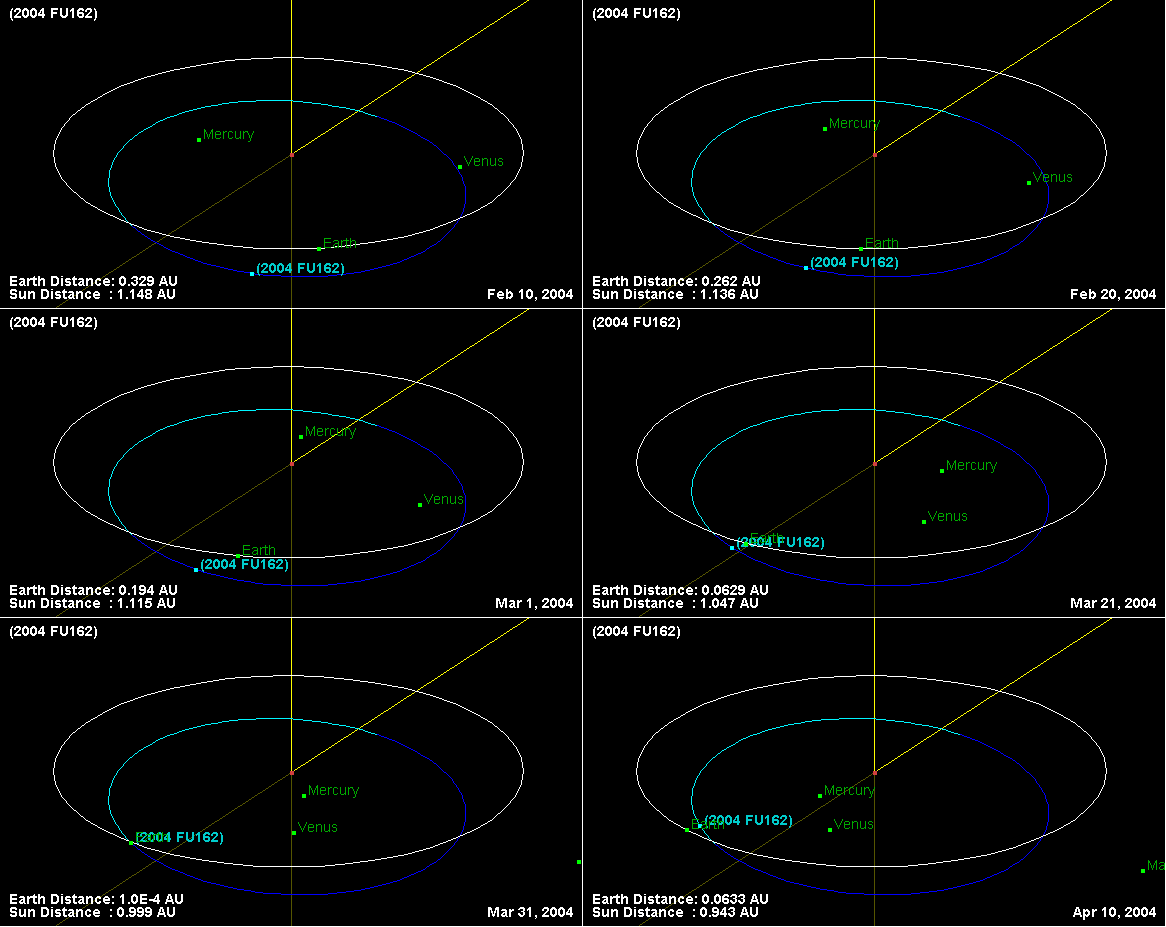
This article will use the NASA JPL orbit simulator to illustrate some of these. If you don't know about the simulator, please read Orbits: Intro to NASA's Orbit Simulator - solar system small body tour.
Before we start, I should put the risk into perspective. For anyone who isn't aware of it the automated searches are happening because the US government realized the long term risk of an impact with something large from space was something they could and should investigate. To date, these studies have identified over a thousand objects to keep our eyes on in their search for potentially hazardous objects. Most of these are too small to cause critical or even major damage. Many of the orbits of others are known well enough to rule them out. The search and monitoring continues, but as of right now, despite some close calls being predicted there are exactly ZERO of these to really worry about.
The Earth is constantly encountering things in space. Meteor showers are caused by dust and small particles left over from comets. Occasionally we get some spectacular fireballs from some larger rocks. Really damaging objects, say larger than a good sized house, are much rarer. And lastly, more of these miss us than hit us. Of all of the objects whizzing by Earth, the most potentially damaging are probably comets. The tend to be bigger and many of them are only being seen for the first time. Fortunately, if you look at the history of comet close calls they have been much farther away than anything else.
Now, a tour of celestial close encounters using the JPL Orbit Simulator
For each of these I recommend adjusting the controls to center on one of the near colliding objects and using the date control to set a date a few days or weeks before the impact or near miss and hit play or step through it. You may notice that some of the simulations aren't perfect, they won't take in all the effects of gravity as objects get very close to planets but they'll give you an idea.
I am taking some liberty in referring to these objects as rocks. Asteroids are now thought to be more like large rock piles rather than single pieces of rock.
1993 F2 ( Comet Shoemaker-Levy 9 ) - ( orbit diagrams, NASA, Wikipedia)
In 1992 this comet passed too close to Jupiter and was torn into fragments setting up a cosmic 21 gun salute and the most spectacular impacts ever seen. Between July 16 and July 22, 1994 twenty one (21) fragments ranging in size up to 2km slammed into Jupiter at over 60 km/s. Under the scrutiny of the Hubble and every spare telescope available the results were spectacular. A couple of the fragments left scars the size of the Earth on Jupiter.
One thing to understand about impacts, the damage done is a factor of kinetic energy and the speed of the object contributes far more to the damage than the size. The same impact at half the speed would only produce 1/4 of the damage.
You'll notice the orbit simulation doesn't quite show a collision or even the orbits intersecting at the right dates. Sorry no kaboom in the simulator.
2007 WD5 - ( orbital diagram, Wikipedia )
While not large enough to cause a Mars shattering kaboom, Marvin the Martian breathed a sigh of relief on January 30, 2008 when this small (50m) rock whizzed by his planet at 12 km/s. Many of Earth's telescopes including the Hubble were watching just in case they might catch the largest ever observed impact on a rocky body. The asteroid's orbit was altered by its close encounter and it is now considered lost.
Note: Smaller impacts have been seen on the Moon and even filmed - see here.
2008 TC3 - ( orbital diagram, Wikipedia )
On October 6, 2008 the automated telescopes of the Catalina Sky Survey detected an object that would hit Earth in less than 24 hours somewhere over north Africa. The meteor (5 m) entered from west to east at a speed of 13km/s and exploded high over the desert near the border of Sudan and Egypt. The explosion was seen by airline pilots, satellites, and people on the ground. Remarkably fragments of the meteor were recovered by researchers after a search of the desert.
This was the first ever predicted meteor strike.
2007 TU24 - ( orbital diagram, Wikipedia )
On January 29, 2008 this rock (250 m) missed Earth by about 1/2 million kilometers or about half again as far away as the orbit of the moon. However, this didn't stop the lunatic fringe from making all sorts of bizarre claims that scientists didn't understand the real threat and it would do all kinds of damage. They even tried to say that some minor events were caused by it. All hogwash.
Comet Halley (1P Halley) - ( orbit diagram, Wikipedia )
The most famous comet returns every 75-76 years has been observed going back to ancient times. It wasn't until Edmond Halley calculated the orbit did people realise it was a repeat visitor. The comet is about 11km in size and irregular (peanut shaped) and follows a retrograde (backwards) orbit attaining speeds of 70 km/s. Dust from the comet is responsible for two meteor showers in October and May.
Comet Holmes (17P Holmes) - ( orbit diagram, Wikipedia, Comet Holmes visits the 433rd! )
Comet Holmes is a very short period of about 7 years and is notable because it periodically has major outburts of gas. On most normal orbits the comet would pass almost unnoticed. But it holds the record for the most major gas outburst of any comet. In 2007 gas and dust cloud around the comet swelled to over 1 million km making it briefly larger than the Sun. The nucleus of this comet is about 3-4km in size.
2004 NM4 (99942 Apophis) - ( orbital diagram, Wikipedia )
This asteroid (270m) discovered in 2004 caused some concern after early calculations showed it might collide with the Earth in 2029 or 2036. It will pass between Earth and our geosynchronous satellites on Friday, April 13, 2009 when it should be as bright enough to be seen even within cities as it moves very quickly across the sky. The asteroid is being studied for risk of future impacts including a possible hit in the Pacific Ocean in 2036 (more study and analysis has shown this to be unlikely).
29075 (1950 DA) - ( orbital diagram, NASA's NEO pages, Wikipedia )
This asteroid (1.1km) is being studied because it is an impact concern for the year 2880. There are many variables that affect the orbit of an asteroid in subtle ways and these are all being studied to get a better understanding of the risk from this and other asteroids. Unfortunately JPL's time machine won't let you go that far into the future.
2004 XP14 - ( orbit diagram, Wikipedia )
On July 3, 2006 this asteroid (300-900m) passed Earth just beyond the orbit of the Moon. This is the closest recorded pass of an asteroid other than the 50m sized 2009 DD4.
4179 Toutatis (1989 AC) - ( orbit diagram, Wikipedia )
A large (2-4km) irregular asteroid that can come within a 1/2 million to a million km of the Earth and Moon about every four years. This may be the largest close approaching asteroid we know of.
Lexell's Comet - ( orbit diagram, Wikipedia )
Set the wayback machine to July 1, 1770 to see the closest recorded pass of a comet to Earth! Lexell passed us with a slender gap of just over 2 million km. The comet is now lost and it's believed that an interaction with Jupiter has altered its orbit.
Update: 2009 HC82 - ( orbit diagram, Universe Today )
Just in, on April 29th the Catalina Sky Survey bagged another very strange one. The object which is 2-3 km in size and has a steep 3.39 year retrograde (backwards) orbit suggesting it may be a burnt-out comet. It also comes within 3.5 million km of Earth's orbit. The team at the sky survey are surprised that this wasn't discovered sooner as it should have been observable nine years ago. Try setting the simulator date to early 2001 and the speed to about 3 days per frame or less, hit the play ">>" button and tinker with the controls. For more see the Universe Today article.
A few more close objects
- Comet 55P Tempel-Tuttle - (3.5 km) and the source of the Leonids with a 33yr orbit - ( orbit diagram, Wikipedia )
- Comet Catalina 3 (2005 JQ5) - once considered an impact risk for 2085 it is 1.4km in size on a 4.5yr orbit - ( orbit diagram, New Scientist )
- 109P Swift Tuttle - a 133 year orbit and the source of the Perseids. Also a possible future Earth/Moon impactor beyond 3000CE - ( orbit diagram, Wikipedia )
- 2004 FU162 - A 6m rock that passed us on March 31, 2004 at a distance of 7,000km - ( orbit diagram, Wikipedia)
- 2004 FH - A 30m rock passing at 43,000km on March 18, 2004 - ( orbit diagram, Wikipedia ).
- 2003 SQ222 - A 5m rock passing 88,000km on Sept
17, 200627, 2003 and detected 11 hours after closest approach. - ( orbit diagram, Universe Today ) - 2009 DD45 - A 50m rock passing us within 63,000km on March 2, 2009 - ( orbit diagram, Wikipedia )
- The JPL orbit simulator Near Earth Object lookup page
- The Harvard Centre for Astrophysics list of close asteroid approaches to Earth
- The Harvard Centre for Astrophysics list of close comet approaches to Earth
- The JPL list of recent and upcoming Neart Earth Object (NEO) close approaches to Earth
- The Harvard Centre for Astrophysics Potentially Hazardous Asteroid Close Approach List
- Andrew Lowes' list of upcoming close passes of objects with the inner planets. Passes closer than 3 million km (0.02 AU) are highlighted in red.
- The Lowell Minimum Orbital Intersect Distances (MOIDs) page. Small MOIDs indicate potential close encounters and opportunities for planets may change the orbits of small bodies.
- There are lists of planet crossing objects (they still call them minor planets) at Wikipedia:
- List of Venus-crossing minor planets
- List of Earth-crossing minor planets
- List of Mars-crossing minor planets
- List of Jupiter-crossing minor planets
- List of Saturn-crossing minor planets
- List of Uranus-crossing minor planets
- List of Neptune-crossing minor planets
- A list of notable asteroids and close approaches at Wikipedia
- October 15, 2008 Southern Ontario fireball
- February 15, 2009 Texas fireball
- March 15, 2009 Southern Ontario fireball
- November 20, 2008, Alberta Fireball
- Evidence of recent Martian bolide impact
Related Articles
See the Sun through an Hydrogen-Alpha filter (May 2 11am-4pm)
Who knows perhaps there'll be a sunspot too?
BTW They're having a tent sale on Saturday May 30th.
Tuesday, April 28, 2009
100 Carnivals (of Space) on the wall
...
Now if one of those Carnivals should happen to fall ....
Ok, I was hoping for a Beer theme and didn't have time to volunteer this week. Just as well a tipsy bat would probably not be a good thing.
Enjoy everyone.
Wednesday, April 22, 2009
Orbits: Intro to NASA's Orbit Simulator - solar system small body tour
So if you are interested in the latest asteroid or meteoroid near miss, potentially hazardous asteroids, newly discovered trans-Neptunian objects, and comets, then you may want to check out JPL's Solar System Dynamics web site and their small body database search with animated orbital diagrams page in particular.
Below I'll walk you through it.
Finding your object
The small body database search lets you lookup a body with the official name like "Eris" or "Apollo", the official number "136199", or the provisional designation, "2003 UB313". Official names can take years to get in the books and lots of science articles, blogs, and even Wikipedia will use the provisional designations and sometimes unofficial names like "Xena" (not kidding) in articles. So if you can't find what you want using a name, you may need to search around to get the identifier.
Once you've found an object you get a very busy looking page with lots of numbers. The numbers will tell you where the object is if you feel the need to do the math. Fortunately, you can skip the math and get the computer to it for you by selecting the link "[show orbit diagram]" near the top left of the page above the first table of numbers. This starts the simulator which runs a little program known as a Java Applet that runs inside your browser.
Using the simulator
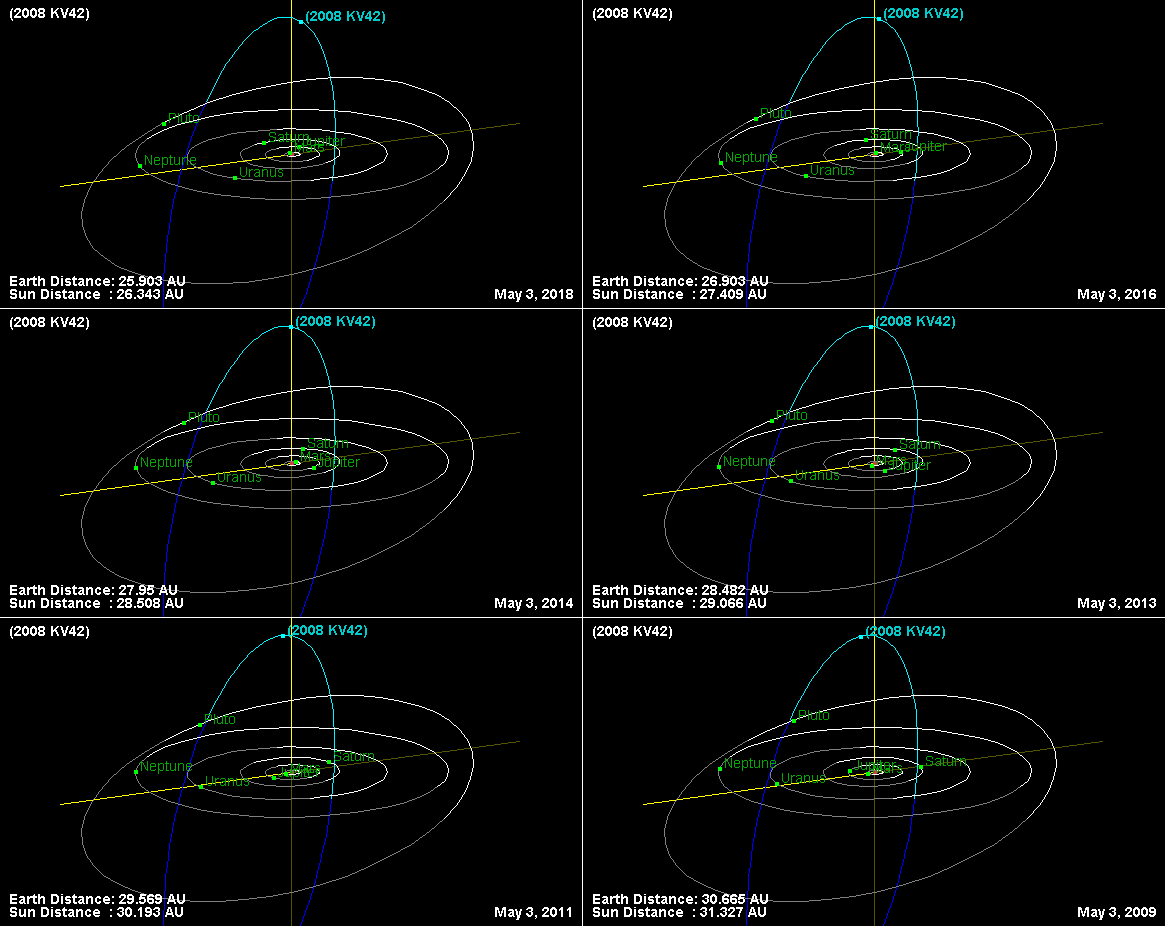
The simulator has lots of controls that you really do want to play with. The diagram below shows some of the controls and how these diagrams start off. You'll notice that the object I've chosen an object isn't in the diagram.

Unless you're interested in the asteroid belt, the Zoom (#1) is probably one of the first things you'll want to adjust
Next you may want to add or remove the orbits (#2). Often you'll only want to see a few orbits. Use the drop down menu and click on the solar system object you wish to add or remove. Each line is like a switch.
Your center of view (#3) will depend on what you're interested in. If you're interested in the big picture leaving it Sun centered is fine. Sometimes you'll be interested in how objects dance around each other and for that you may want to center on one of them.
The player controls (#4) let you step or run the simulation backwards or forwards at different rates of speed from hours to a year. You can wind the clock back to 1600CE or forward to 2200CE.
 Lastly, you can change your vantage point (#5) moving around to see the solar system from below or above and rotating left or right around the plane of the ecliptic. You should notice that the shade of the orbit lines changes when an object crosses above of below the ecliptic.
Zooming out brings the object into the diagram and shows its first odd characteristic.
It has a very strange orbit that is almost vertical off the plane of the ecliptic and all the major planets.
It's also a long way off over 30 AU (30 times the distance from the Sun to the Earth) from us.
The orbits of the outer planets are missing in the diagram but they can be brought back by selecting "all orbits".
To get to the animation at the start of the article I next needed to adjust the rotation controls. It's the animation that shows what still frames will not. In this case, the final odd characteristic of this object that it orbits backwards from the other planets in what is called a retrograde orbit.
This tiny rock has been nicknamed "Drac" after Dracula for it's strange ability to "climb the walls". And if you want to try it yourself look up 2008 KV42 - ( orbital diagram, Wikipedia ).
Try Exploring Some Other Solar System Objects
If you're curious about some of the smaller solar system look at the following links. Below are a number of dwarf planets, objects being considered for dwarf planet status, and asteroids (listed in order of discovery).
This list may provide some insight into the current debate over the planetary status of Pluto and others. Three times have astronomers revised thieir opinion about what a planet is.
Discoveries leading to the second planet debates
- 1 Ceres - 1st asteroid, former planet and now dwarf planet - (orbital diagram, Wikipedia)
- 2 Pallas - 2nd asteroid, former planet and largest asteroid not a dwarf planet - (orbital diagram, Wikipedia)
- 3 Juno - former planet - (orbital diagram, Wikipedia)
- 4 Vesta - former planet - (orbital diagram, Wikipedia)
- 5 Astraea - prototype asteroid leading to reclassification - (orbital diagram, Wikipedia)
- 134340 Pluto - former planet, now (somewhat miffed) dwarf planet and prototype for all Plutinos - (orbital diagram, Wikipedia)
- 20000 Varuna (2000 WR106) - (orbital diagram, Wikipedia)
- 50000 Quaoar (2002 LM60) - first large discovery after Pluto - ( orbital diagram, Wikipedia )
- 136108 Haumea (2003 EL61) - a football shaped dwarf planet - ( orbital diagram, Wikipedia )
- 136199 Eris (2003 UB313) - aka "Xena", a dwarf planet larger than Pluto - ( orbital diagram, Wikipedia )
- 90377 Sedna (2003 VB12) - longest orbit by far - ( orbital diagram, Wikipedia )
- 90482 Orcus (2004 DW) - the "anti-Pluto" - ( orbital diagram, Wikipedia )
- 136472 Makemake (2005 FY9) - bright and distant dwarf planet - ( orbital diagram, Wikipedia )
And if you're wondering about the first debate, it got Galileo confined to house arrest by the Church. For more see The Last Planet?
Update: Pictorial representation of all known solar system objects 200 miles in diameter or larger at Kokogiak.com.
More on the Simulator
For anyone interested, the Java source code for the simulator can be found at Astroarts.
If you're learning Java and so inclined you might want to try your hand at some enhancements here are a few suggestions:
- The ability to put up multiple objects on the same diagram
- Extending the simulation time frames
- Passing parameters for controls such as date, zoom, center, and others into the applet
- The ability to send a link to people showing what you've set
- Showing distance from a centered planet to the object
- Orbits of moons around an object or planet
- The ability to show the gravity well of a planet that might affect an object
- Dual speed controls or the ability to stop the player if two objects get within a specified distance
For astronomers that need better data, the JPL maintains a system with higher accuracy data known as ephemerides (the numbers that define orbits). The JPL Horizons system contains information on almost half a million solar system objects including 451644 asteroids, 2980 comets, 169 planetary satellites, 8 planets, the Sun, and some spacecraft. The catch is that you'll have to do the math. Each page in the simulator links to the Horizon data for the same object so you don't have to do the lookup twice.
Related Articles
Sunday, April 19, 2009
Monday, April 13, 2009
The Last Planet?
What I believe we have here is a small scale version of the kind of knowledge shift that James Burke described in The Day the Universe Changed. And while this is a smaller, it's also more significant than just the Day Our Solar System Changed. Burke's commentary is insightful and points out how the state of our knowledge prejudices our thinking. As an example he cites a story told about the philosopher Ludwig Wittgenstein (found here):
Somebody apparently went up to [Wittgenstein] and remarked what a bunch of morons we in Europe must have been (800 years ago before Copernicus told us how the solar system works) to have looked up there and thought that what we were seeing was the Sun going around the Earth, when as any idiot knows the Earth goes round the Sun, and you don’t have to be Einstein to understand that.
To which Wittgenstein is said to have replied… “But I wonder what it would have looked like if the sun had been going around the earth.” The point being of course that it would have looked exactly the same.So how does this make Pluto the last planet?
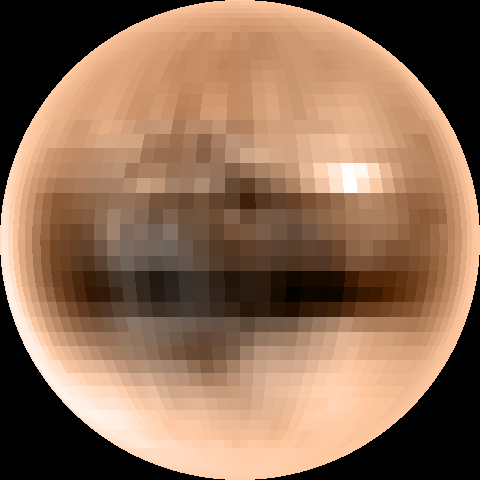
Unless you are a space or astronomy buff you can be forgiven for not knowing about the controversy over the International Astronomical Union (IAU)'s decision that Pluto isn't a planet. Pluto is far from the first object to be kicked out of the planet club. In fact, you may be surprised at some of the others that were kicked out before it.
It turns out that the term planet had no formal scientific definition before 2006. Essentially, everyone was operating on a defacto understanding that had evolved and changed over thousands of years. Planet meant wanderer and included the naked eye planets Mercury, Venus, Mars, Jupiter and Saturn, as well as the Moon and the Sun! The Earth wasn't a planet because people beleived that everything revolved around it.
Telescopes made it possible to find more things in the sky that we couldn't see. It also helped change our view of the Earth-centric system. Once we realised that the Earth and everything else in the Solar system orbited the Sun then the planet club changed dramatically. Both the Sun and Moon had to go and the Earth was a new member. And if our moon wasn't a planet, neither could the moons of Jupiter discovered by Galileo.
As we began to see more wandering objects out there, the ranks of planets swelled. Uranus was discovered in 1781. The dwarf planet Ceres and large asteroids Pallas, Juno, and Vesta were discovered from 1801-1807 and joined the club until more asteroids were discovered begining with Astraea in 1845. A year later Neptune was discovered after a hunt based on prediction and calculation. Yet more calculations suggested another planet (that became known as Planet X) existed beyond Neptune.
The hunt for the mysterious Planet X began in 1900. Pluto was photographed in 1915 but it was missed. Finally, in 1930 Pluto became the last planet. Almost half a century passed until scientists realized that the calculations that predicted Pluto were based on inaccurate data. The discovery of Pluto had been an accident. Better observations also confirmed that that Pluto was both smaller than originaly thought and not alone.
The problem was that the accelerating pace of discoveries in astronomy threatened to challenge the understood definition of planet and the potential for future discoveries created further uncertainty.
So the IAU, the organization responsible for coordinating all things astronomical, decided they needed some consistency and thought a definition would be helpful. After having upheld Pluto's status as a planet in 1999, they investigated and then failed to come to a consensus on a definition of planet. At the 2006 meeting the IAU was faced with confirming a tenth planet if things remained unchanged. A last minute vote on a hasty resolution of an arguably flawed definition set the seeds for this unusual debate. Pluto was out.
The new definition removed Pluto from the list of planets and effectively barred entry for a number of recently discovered planet-like objects, specifically Eris (larger than Pluto), Sedna, Makemake, Orcus, Quaoar, Varuna, and Haumea. While the new definition has some merit, it is unsatisfying, poorly explained, and biased to some degree to objects located closer to the Sun. It also leaves out about 335 (at time of this writing) exoplanets that orbit other stars. Worse Pluto is now formally defined as a "dwarf planet" (but not a planet) which is linguistically confusing to say the least.
The reaction to the new definition was anything but sedate. Blogs abounded with opinion, facts, emotion, and misinformation. There were even web sites set up to promote both sides of the debate. And in bizarre reaction, the sates of New Mexico and Illinois jumped in with legislation to formally recognize Pluto as a planet.
I for one don't believe having planet preceded by an adjective is going to confuse the general public or force people to memorize larger lists of planet names. To me a dwarf planet is still a planet. No confusion. But a dwarf planet not also being a planet is just odd. The general public would be right to ask what planet the academics that thought that one up came from.
The specialists already have a veritable zoo of names for the things they are studying. And these are not names that will resonate with the general public - nor should they. While most people can probably figure out what a Trans Neptunian Object; is their eyes will propably glaze over with terms like Plutinos, Twotinos and Cubewanos.
Any specialized field has specific terminology. Beyond this there is the public or the educated public. These groups are not going to fully share the same terminology and it isn’t desirable that they do. It’s therefore a goal to have the terminology not conflict or contradict in serious ways. This allows the public to be imprecise but still generally in the same direction. It also allows the specialist to pursue high degrees of precision. In short, it allows different groups and audiences to use a degree of precision appropriate to their needs.
Frankly, I believe that the IAU overreached and erred in trying to define something that they never had control of in the first place! Indeed, the IAU should generalize or formally undefine “planet”, demote the lot, and instead provide more precise terms for scientific use. The term "planet" WILL continue to be used by the general public and educators as an introduction to the subject.
Far from being demoted, Pluto will be remembered for forcing this much needed rethink. Of course, Pluto would not be in this position without the (relatively) recent advances in the study of things orbiting stars including Eris, etc. and exoplanets.
Finally and regardless of the names there a lot of interesting and newly discovered things orbiting our Sun. A sample of which a sample includes:
- Orcas a dwarf planet that has been described as the anti-Pluto with an almost identical orbit but on the opposite side of the solar system like some giant cosmic balance. The yang to Pluto's ying. It's newly discovered moon S/1 90482 (2005) is looking for a name. (Personally I like Vanth as a kind of anti-Charon but there have been a lot of other good suggestions). Update: Vanth it is! See Orcus Porcus.
- Haumea a football shaped dwarf planet.
- Drac with its "climbing the walls" orbit around our Sun that is not only nearly vertical but backwards.
- Charon and Pluto the first known binary (dwarf) planet.
-----
Over at AstroProf there is a great series of (longish) articles exploring the history and reasoning behind the current debate over what is and what is not a planet.
- Defining Planets (Part I) - Introduction and Background to the Debate
- Defining Planets (Part II) - Our changing understanding of Pluto the outsider
- Defining Planets (Part III) - More Plutos, more criteria, and the search for a definition
- Defining Planets (Part IV) - Size matters, or does it?
- Defining Planets (Part V) - It's what is on the inside that counts?
- Defining Planets (Part VI) - Structure, Differentiation, and Hydrostatic Equilibrium?
- Defining Planets (Part VII) - How they're made?
- Defining Planets (Part VIII) - Wanderers, Visibility, and order of discovery: Back to the basics?
- Defining Planets (Part IX) - Clearing their Orbit and ideas based on some heavy math?
- Defining Planets (Part X) - Conclusion
- Ten Things You Don’t Know About Pluto | Bad Astronomy
- Episode 64: Pluto and the Icy Outer Solar System | Astronomy Cast
- Episode 1: Pluto's Planetary Identity Crisis | Astronomy Cast
- 2012: No Planet X | Astroengine (and the rest of the No 2012 doomsday series)
- Update: Pluto's Big Hill to Climb a discussion about why characteristics of orbital dynamics (like clearing the neighbourhood) may not make for good classifications
Some other articles and web sites that may be of interest covering this topic include:
- Update: Pluto Could Still Be A Planet! (Who Cares?) | astroengine
- Update: Is Pluto a planet after all? | New Scientist
- Ground Rules for Debating the Definition of Planet | Mike Brown's Planets
- Is Pluto a Planet? | The Planetary Society - Bill Nye
- Pluto officially declared not a planet | The Planetary Society
- Why is Pluto Not a Planet | Universe Today
- Pluto's Out of the Planet Club | Universe Today
- Planet or Not, Pluto Beckons | The Planetary Society
- Giving Pluto Another Chance | Music of the Spheres
- Why Pluto had to go | COSMOS magazine
- Sorry Pluto, Eris is Bigger | Universe Today
- New Mexico Declares Pluto a Planet | About.com
- Illinois restores Pluto's planetary status | The Register
- The Status of Pluto: a Clarification | IAU Press Release 1999
- The Great Planet Debate | Sky and Telescope
- Spirited Pluto Battle, But a Great Debate? | Discovery - Cosmic Ray
- The Pluto Revolt: Leading Astronomers Want the Plutoid to be Reinstated as a Planet | Universe Today
- My thoughts on the Great Planet Debate | The Planetary Society
- The IAU draft definition of "planet" and "plutons" | IAU News Release 2006"
- Result of the IAU Resolution votes | IAU News Release 2006
- FAQ on the new definition of planet | IAU
- Pluto |
NineEight Planets - Naming Names Around Pluto
Thanks to little David, one of our Beavers, who was a bit upset about Pluto's being demoted.
Tuesday, March 31, 2009
Carnivals of Space 92, 93, 94, 95, and 96
- Carnival of Space #96: The Questions Edition @ Astroengine
- Carnival of Space #95: from Toronto @ Orbital Hub
- Carnival of Space #94: from the Lunar Librarian @ Out of the Cradle
- Carnival of Space #93: From our own planet, to exoplanets @ The Planetary Society
- Carnival of Space #92: launch failures and Martians @ The Launch Pad and side show
Tuesday, March 24, 2009
Earth Hour: Be Part of It

While Earth Day is about general environmental awareness, Earth Hour’s purpose is to inspire people to take action on climate change. It shows that by turning off non-essential lighting we can reduce electricity use and greenhouse gas emissions. Energy saved during Earth Hour 2008 was estimated from 2%-10% depending on sources (the equivalent of taking about 50,000 cars off the road for an hour). However, the event is not so much about direct energy savings as education and change. It’s a way to make people think about climate change and how they can make a difference.
Earth Hour started March 31st, 2007 in Sydney, Australia, when over two million people and two thousand businesses turned their lights off for one hour.
It went international in 2008 in over 400 cities worldwide. The 35 flagship cities included Montreal, Ottawa, Toronto, and Vancouver. Every Canadian province and territory participated.
Earth Hour 2009
Earth Hour 2009 will be a half hour later to be more in line with astronomical twilight and daylight savings in North America. It’s hoped that more than one billion people around the world will turn their lights out. Participants will get the chance to see truly dark skies and better appreciate the impact of light pollution. Amateur astronomers will set up telescopes to show people the wonders of our night skies as they were meant to be seen. Find out more from the Royal Astronomical Society of Canada (RASC at www.rasc.org) and local newspapers.
How Can You Join In?
Once you’ve made the decision to participate in Earth Hour, your choice of what to do will depend on where you are. Will you be at camp? Get outside and go for a night hike; gather around a campfire to sing songs and tell stories.
Will you be at your meeting place, providing a place for the community to come together? Do some advance
promotion before the date.Write to your local newspaper and tell them what you’re doing. Invite community leaders, parents, your sponsors. Make tin can lanterns to light the area, or beeswax candles to give away. With appropriate permission, fire up the barbecue for hot chocolate, tea and coffee. Organize
an astronomy/stargazing event with your youth to take advantage of the darker skies.
Visit the Earth Hour web site (http://www.earthhour.org/) to register and receive more information.
The Climate Change Connection
Early environmental concerns focused on pollutants and toxins. Awareness of the impact of greenhouse gases came later. Burning fossil fuels releases CO2 (that has been out of circulation for tens of millions of years) back into the environment. This differs from the burning of renewable resources such as plants where the CO2 is part of a much shorter cycle. Excess CO2 has been building up for the last 150 years.
Much of the electric power used for lighting is wasted as excess heat and light. Outdoor lighting blasts skywards instead of being focused. Light pollution also adversely affects people and animals. The study of this is called scotobiology.
Some of the biggest offenders are:
- Incandescent lamps waste about 90% of their energy by producing heat.
- Many large signs are not designed to be shut off.
- Standby modes for appliances built in the last 20 years may be inefficient and wasteful.
scientific evidence that it is real and caused by human activities. Less clear is whether or not it can be stopped or corrected before the consequences are too severe.
How Can we Solve this Problem?
The solution to climate change won’t be one thing. Rather it will be a combination of behavioral and technological changes: improvements in conservation, more efficient technologies, different power generation strategies, and possibly sequestering (storing) greenhouse gases.
We need to look carefully at a wide range of solutions. Modern communications technologies may make it possible to reduce travel. Alternate power technologies such as wind and solar will help, but are not likely to be enough by themselves.
Key parts of the solution may yet come from unexpected places. People, business, government, and research need to work on solutions; more attention will result in less greenwash. People will adopt solutions that save money and time – the right direction and motivation will allow real solutions to evolve and emerge.
Climate change may very well be the most serious long-term problem to face mankind. Getting it wrong could lead not only to environmental and natural disasters, but also to wars and manmade disasters as parts of our world are stressed by changes.
Earth Hour is symbolic and while it may reduce some greenhouse gas emissions, its real purpose is to light the way to a better future. So join in, turn off your lights, step outside and look up. And while you enjoy the delights of dark skies, think about how we can work together to overcome this challenge.
— David Gamey is an enthusiastic Scouter with the 433rd
Toronto Scouting Group and an amateur astronomer.
This article by David Gamey previously appeared in Scouting Life Magazine and is reprinted with permission of Scouts Canada.
Related Activity
The Globe at Night is a project that measures light pollution around the world. This spring the project is running the week leading into Earth Hour.
It works by getting people to observe the constellation Orion to see which stars are visible. Visit their site to get charts and information on how to report your results.
Consider measuring both during and after Earth Hour.
Related Articles
- Make Your Stargazing Events Shine - reprinted from Jan/Feb 2009 Scouting Life
- Explore the Night Sky - reprinted from Jan/Feb 2009 Scouting Life Magazine
- Astronomy Links from Jan/Feb 2009 Scouting Life Magazine
- Earth Hour: Be Part of It - PDF format from Scouting Life
- Earth Hour: Be Part of It - PDF format from the 433rd
Monday, March 16, 2009
Mang NOT seen hitchhiking at Kenedy Space Centre.
Rumors persist that Mang, a well known bat, hitched a ride on the orbiter after his recent return from space where he was piloting a space telescope. Despite evidence including photos, here this was not Mang but another bat named Brian (according to Dr Ian O'Neill).
Also, Brian clearly was not a Scout as can be seen from the lack of protective gear for either the journey or the last minute escape.
Either way, we suspect that Brian may have Gone Home (i.e. he's an ex-bat) if he didn't get away well before launch.
Good luck Brian, where ever you are!
Update: It seems that Brian indeed has gone home. Reports indicate that he did not fly away, was not frozen, and was observed clinging to the external fuel tank of the orbiter as it lifted from the pad. It is believed Brian may have been injured and could not fly away. For more info, photos, and even a song (Major Tom) adapted to honor him - see here and here. (Strangely I have an image from the movie Toy Story stuck in my head - the vibrating face of Woody the Cowboy as he, RT and Buzz strapped to a rocket blast off from the road in pursuit of the moving van - only this time it's Brian face). It's not known how long he could have held on but we can only hope.
God speed, Brian - the world's first hypersonic space bat.
Subscribe to:
Posts (Atom)
 Subscribe to the RSS (Atom) feed


