People are fascinated by the prospect of near misses and impacts by asteroids, comets, and meteors. A few decades ago there was almost no awareness of the potential risks. As automated search telescopes like
LINEAR and the
Catalina Sky Survey are being used to study the risk, the public is becoming more aware of the numbers of near misses and the potential danger. There is also a great deal of work being done on
how to change the course of potential impactors.
This article will use the NASA JPL orbit simulator to illustrate some of these. If you don't know about the simulator, please read
Orbits: Intro to NASA's Orbit Simulator - solar system small body tour.
Before we start, I should put the risk into perspective. For anyone who isn't aware of it the automated searches are happening because the US government realized the long term risk of an impact with something large from space was something they could and should investigate. To date, these studies have identified over a thousand objects to keep our eyes on in their search for potentially hazardous objects. Most of these are too small to cause critical or even major damage. Many of the orbits of others are known well enough to rule them out. The search and monitoring continues, but as of right now, despite some close calls being predicted there are exactly ZERO of these to really worry about.
The Earth is constantly encountering things in space. Meteor showers are caused by dust and small particles left over from comets. Occasionally we get some spectacular fireballs from some larger rocks. Really damaging objects, say larger than a good sized house, are much rarer. And lastly, more of these miss us than hit us. Of all of the objects whizzing by Earth, the most potentially damaging are probably comets. The tend to be bigger and many of them are only being seen for the first time. Fortunately, if you look at the history of comet close calls they have been much farther away than anything else.
Now, a tour of celestial close encounters using the JPL Orbit Simulator
For each of these I recommend adjusting the controls to center on one of the near colliding objects and using the date control to set a date a few days or weeks before the impact or near miss and hit play or step through it. You may notice that some of the simulations aren't perfect, they won't take in all the effects of gravity as objects get very close to planets but they'll give you an idea.
I am taking some liberty in referring to these objects as rocks. Asteroids are now thought to be more like large rock piles rather than single pieces of rock.
1993 F2 ( Comet Shoemaker-Levy 9 ) - (
orbit diagrams,
NASA,
Wikipedia)
In 1992 this comet passed too close to Jupiter and was torn into fragments setting up a cosmic 21 gun salute and the most spectacular impacts ever seen. Between July 16 and July 22, 1994 twenty one (21) fragments ranging in size up to 2km slammed into Jupiter at over 60 km/s. Under the scrutiny of the Hubble and every spare telescope available the results were spectacular. A couple of the fragments left scars the size of the Earth on Jupiter.
One thing to understand about impacts, the damage done is a factor of
kinetic energy and the speed of the object contributes far more to the damage than the size. The same impact at half the speed would only produce 1/4 of the damage.
You'll notice the orbit simulation doesn't quite show a collision or even the orbits intersecting at the right dates. Sorry no kaboom in the simulator.
2007 WD5 - (
orbital diagram,
Wikipedia )
While not large enough to cause a Mars shattering kaboom, Marvin the Martian breathed a sigh of relief on January 30, 2008 when this small (50m) rock whizzed by his planet at 12 km/s. Many of Earth's telescopes including the Hubble were watching just in case they might catch the largest ever observed impact on a rocky body. The asteroid's orbit was altered by its close encounter and it is now considered lost.
Note: Smaller impacts have been seen on the Moon and even filmed - see
here.
2008 TC3 - (
orbital diagram,
Wikipedia )
On October 6, 2008 the automated telescopes of the Catalina Sky Survey detected an object that would hit Earth in less than 24 hours somewhere over north Africa. The meteor (5 m) entered from west to east at a speed of 13km/s and exploded high over the desert near the border of Sudan and Egypt. The explosion was seen by airline pilots, satellites, and people on the ground. Remarkably fragments of the meteor were recovered by researchers after a search of the desert.
This was the first ever predicted meteor strike.
2007 TU24 - (
orbital diagram,
Wikipedia )
On January 29, 2008 this rock (250 m) missed Earth by about 1/2 million kilometers or about half again as far away as the orbit of the moon. However, this didn't stop the lunatic fringe from making all sorts of bizarre claims that scientists didn't understand the real threat and it would do all kinds of damage. They even tried to say that some minor events were caused by it. All hogwash.
Comet Halley (1P Halley) - (
orbit diagram,
Wikipedia )
The most famous comet returns every 75-76 years has been observed going back to ancient times. It wasn't until Edmond Halley calculated the orbit did people realise it was a repeat visitor. The comet is about 11km in size and irregular (peanut shaped) and follows a retrograde (backwards) orbit attaining speeds of 70 km/s. Dust from the comet is responsible for two meteor showers in October and May.
Comet Holmes (17P Holmes) - (
orbit diagram,
Wikipedia,
Comet Holmes visits the 433rd! )
Comet Holmes is a very short period of about 7 years and is notable because it periodically has major outburts of gas. On most normal orbits the comet would pass almost unnoticed. But it holds the record for the most major gas outburst of any comet. In 2007 gas and dust cloud around the comet swelled to over 1 million km making it briefly larger than the Sun. The nucleus of this comet is about 3-4km in size.
2004 NM4 (99942 Apophis) - (
orbital diagram,
Wikipedia )
This asteroid (270m) discovered in 2004 caused some concern after early calculations showed it might collide with the Earth in 2029 or 2036. It will pass between Earth and our geosynchronous satellites on Friday, April 13, 2009 when it should be as bright enough to be seen even within cities as it moves very quickly across the sky. The asteroid is being studied for risk of future impacts including a possible hit in the Pacific Ocean in 2036 (more study and analysis has shown this to be unlikely).
29075 (1950 DA) - (
orbital diagram,
NASA's NEO pages,
Wikipedia )
This asteroid (1.1km) is being studied because it is an impact concern for the year 2880. There are many variables that affect the orbit of an asteroid in subtle ways and these are all being studied to get a better understanding of the risk from this and other asteroids. Unfortunately JPL's time machine won't let you go that far into the future.
2004 XP14 - (
orbit diagram,
Wikipedia )
On July 3, 2006 this asteroid (300-900m) passed Earth just beyond the orbit of the Moon. This is the closest recorded pass of an asteroid other than the 50m sized 2009 DD4.
4179 Toutatis (1989 AC) - (
orbit diagram,
Wikipedia )
A large (2-4km) irregular asteroid that can come within a 1/2 million to a million km of the Earth and Moon about every four years. This may be the largest close approaching asteroid we know of.
Lexell's Comet - (
orbit diagram,
Wikipedia )
Set the wayback machine to July 1, 1770 to see the closest recorded pass of a comet to Earth! Lexell passed us with a slender gap of just over 2 million km. The comet is now lost and it's believed that an interaction with Jupiter has altered its orbit.
Update: 2009 HC82 - (
orbit diagram,
Universe Today )
Just in, on April 29th the Catalina Sky Survey bagged another very strange one. The object which is 2-3 km in size and has a steep 3.39 year retrograde (backwards) orbit suggesting it may be a burnt-out comet. It also comes within 3.5 million km of Earth's orbit. The team at the sky survey are surprised that this wasn't discovered sooner as it should have been observable nine years ago. Try setting the simulator date to early 2001 and the speed to about 3 days per frame or less, hit the play ">>" button and tinker with the controls. For more see the Universe Today article.
A few more close objects
- Comet 55P Tempel-Tuttle - (3.5 km) and the source of the Leonids with a 33yr orbit - ( orbit diagram, Wikipedia )
- Comet Catalina 3 (2005 JQ5) - once considered an impact risk for 2085 it is 1.4km in size on a 4.5yr orbit - ( orbit diagram, New Scientist )
- 109P Swift Tuttle - a 133 year orbit and the source of the Perseids. Also a possible future Earth/Moon impactor beyond 3000CE - ( orbit diagram, Wikipedia )
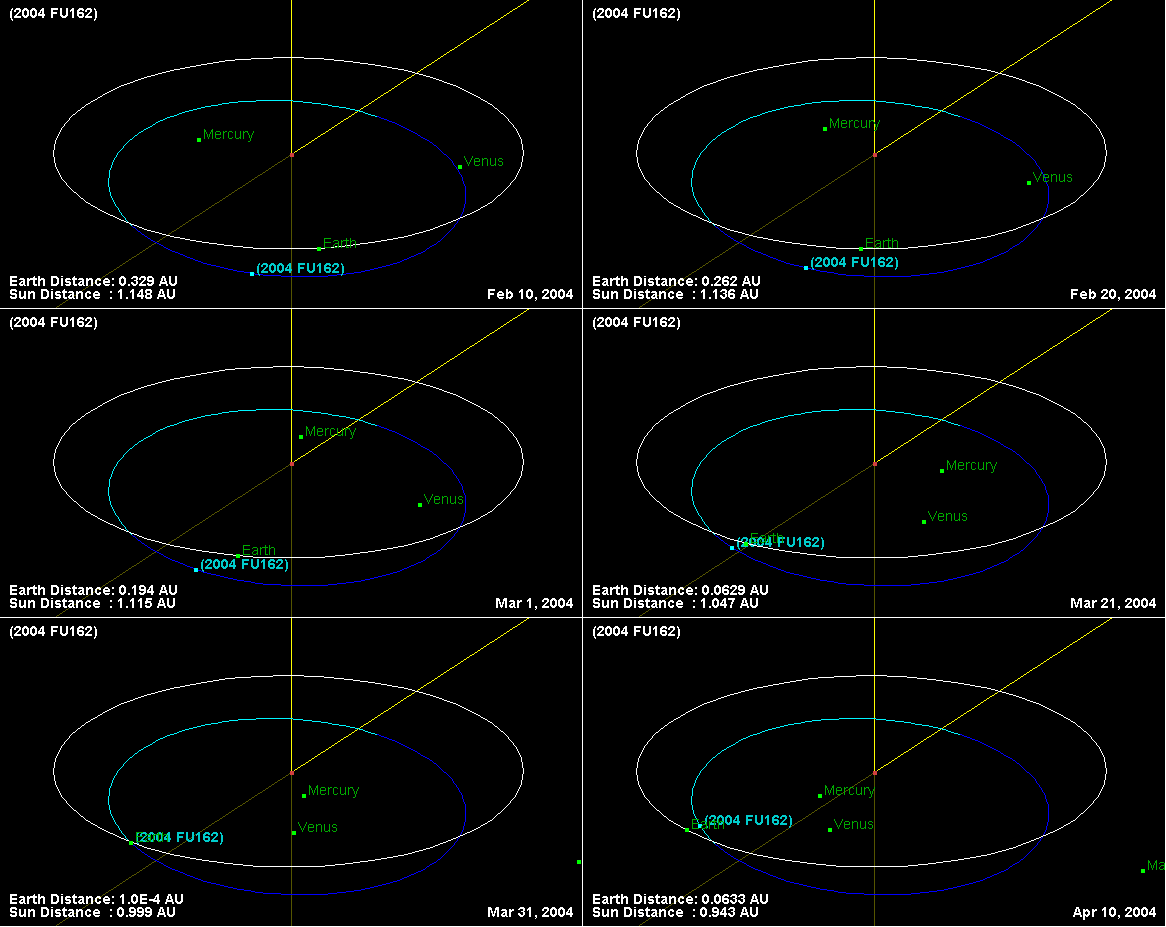
- 2004 FU162 - A 6m rock that passed us on March 31, 2004 at a distance of 7,000km - ( orbit diagram, Wikipedia)
- 2004 FH - A 30m rock passing at 43,000km on March 18, 2004 - ( orbit diagram, Wikipedia ).
- 2003 SQ222 - A 5m rock passing 88,000km on Sept
17, 2006 27, 2003 and detected 11 hours after closest approach. - ( orbit diagram, Universe Today )
- 2009 DD45 - A 50m rock passing us within 63,000km on March 2, 2009 - ( orbit diagram, Wikipedia )
More Information on Near Earth Objects, Potentially Hazardous Asteroids and Minor Planets
Some recent fireballs (we don't have orbits for) bolides is the proper name:
Update: Some very interesting tibits from the Planetary Defense Conference on the sizes and numbers of discoveries of NEOs can be found
here at Planetary Sociecty Blog. And a
second article talking about what could be done if we knew we were going to be hit.
Related Articles


 Subscribe to the RSS (Atom) feed


