Ever wonder about just how big the International Space Station is? USA Today published a nice animation from NASA showing all the flights and modules added to it over the years.
The ISS is now the brightest object in the night sky next to the Moon. If you want to see it, check out the Heavens Above web site and enter your location.
If you're going to a Scout Camp, you may be able to find use on of my Combined Sky Forecast Charts.
Showing posts with label SpaceExploration. Show all posts
Wednesday, July 8, 2009
Saturday, May 2, 2009
Space badge resource for Girls and Boys
Ken Murphy over at Out of the Cradle wrote a piece on Girl Scout space badges in Scouting the Moon. The article also has some references to US Boy Scout Space Exploration merit badge and the interesting online resource meritbadge.org.
(See what you can find when you read Carnival of Space, h/t to Issue #101)
Labels:
Badgework,
CarnivalOfSpace,
ScoutBlogs,
SpaceExploration
Wednesday, January 28, 2009
How You Could Pilot a Space Telescope (Upside Down)
This is the second in a series of articles on my experiences working with the MOST team on a study of Betelgeuse. This time, I look at the process of selecting targets and pointing the telescope.
When I first heard about public proposals for MOST (Microvariability and Oscillations of STars), I was quite interested and spent some time reading up on MOST on both the main web site and the outreach web site called MOST = My Own Space Telescope. I needed to understand both the capabilities of MOST and its limitations.
I should note that the proposal site is still open and accepting proposals. Just perhaps, you too may get a chance to pilot a space telescope.
What can MOST do?
MOST was designed to detect minute variations in light intensity in stars which turns out to be very useful if you are looking at things like:
It turns out there are lots of things on which MOSTs strengths can be brought to bear:
The MOST Science Team chooses targets based on the science they want to explore. What types of variations can teach them about the nature and life story of a star or planets around it? Are those variations likely in a particular star? And is MOST sensitive enough to see those particular variations in that particular star?
I think of this as the “bottom up” approach. I decided that as an amateur not immersed in the details and subtleties of astrophysics my best bet would be to play a different game and try a top down approach.
This approach led me to make a list of visually interesting and recognizable stars most of which were observable with the naked eye. My reason for choosing recognizable stars was to better connect with the public. Next I investigated the list for stars that would be (a) accessible to MOST and (b) suitable science targets for its mission. Again the order may seem upside down but determining visibility was easier to do in bulk than doing the research first.
My initial list contained over 50 stars and resulted in five proposals covering six stars. Below are a few of the ones not accessible to MOST for long durations:
How do I aim this thing?
The MOST = My Own Space Telescope public proposals page contains a lot of background on choosing target stars for MOST and the process for the public to submit proposals. Once you've selected an interesting target, you need to ensure that MOST can see it.
Targets (with some exceptions) need to be meet two major positional constraints (1) the CVZ or Continuous Viewing Zone, and (2) the SSR or Sun Sensor Range. The CVZ dictates how long MOST can look at a star without interruption and the SSR constraint has to do with MOST keeping its back and its main solar panels to the Sun (as shown below on the left), as well as maintaining a reasonable temperature for the spacecraft. The proposal site has a Java based Target Validation Tool that checks all of this but I built one in a spread sheet to work with my long list.
The second chart (above and to the right) shows a plot of some of the target stars that have been selected and proposed as candidates. The red arrows point to Betelgeuse and LG 5039 (a microquasar) - the first two winning proposals submitted by myself and by Gordon Sarty.
Proposal Review by MOST Team
The proposals were examined by the MOST Science Team to ensure that the candidates were likely to yield good science data; and by the Operations Team to ensure that the target could be safely observed by the satellite. Successful proposals are announced and scheduled.
I should say a few words about the proposals themselves. The information needed by the team is not large. They need to know the target star, its name (or identifier) and coordinates, your contact information, and a brief description of why you think this would be a good subject of study. If you feel the need to write a bit more, there is a place to attach a small document. You can find the submission form here.
Fine Tuning the Aim
MOST follows a Science Target by tracking Guide Stars near the target in the telescopes field of view. All of the Target and Guide Stars must to be within a maximum of 0.86 degrees (a bit less than the twice the diameter of the full Moon). There must be enough Guide Stars of suitable brightness close to a target for that star to be observed. That is not normally a problem.
The spacecraft can be “rolled” around the position of the target to optimise the guide star selection and to include stars which are also of scientific interest. MOST can monitor up to about 40 stars at a time, greatly increasing the scientific returns. The roll angle of the satellite is also chosen to minimise scattered light from the Earth (“Earthshine”) falling onto the focal plane of the instrument. The Team then maps out the positions of the Primary Science Target, Direct Imaging Targets and Guide Stars. The image below shows the MOST target map for Betelgeuse:
As you can see, Betelgeuse (shown by the cross-hairs) is positioned under one of the central Fabry microlenses. The boxes show Guide Stars used to keep MOST pointing at Betelgeuse.
While in theory only two guide stars are required to keep the satellite pointed, in practice up to about 5 or 6 are actually used. All of these images are defocused over several pixels so that even minute variations in the intensity of the pixels watching a guide star can be used to detect and correct for any drift.
Another targeting wrinkle is that stars move ever so slightly due to what is know as "proper motion". Closer stars move more than ones further away. For example, Procyon (which has been studied by MOST) is very close to us compared to Betelgeuse and has a very much higher proper motion. The solution, a maneuver known as cross-hairs, takes sample measurements around the coordinates with the results being reviewed to fine tune the aim.
Keeping MOST on Target
MOST is able to keep itself pointed to a high degree of accuracy by combining information from several sensors that are listed below:
The other trick behind the ability of MOST to stare down a star for almost two months continuously is the orbit of the satellite. MOST orbits the Earth once about every 100 minutes but in a highly inclined orbit that keeps it moving east to west near the terminator so it can keep its back to the Sun and its front looking into the dark of deep space. Here is a track from Heavens Above of the orbit from near my location.
Switch Targets!
Not all targets require continuous observation and MOST has the ability to switch from one target to another in mid orbit. The process itself takes only a couple of minutes and it also means that some stars that are within the Sun Sensor limits but outside of the CVZ can be observed.
In fact one of my proposals was for pairs of targets which could be switched.
Here there beDragons Protons!
One of the hazards MOST faces is radiation. A stray zap from a high-energy particle can scramble its software or damage its components. And MOST travels through a particularly hazardous realm known as the South Atlantic Anomaly (a low arm of the inner Van Allen radiation belt).
The SAA is a potential satellite killer and MOST normally sails through it without harm. About once every two months, a cosmic ray hit during SAA passage can cause an on-board crash, from which MOST recovers usually by its next orbit. However, in January 2006, a very energetic particle hit disabled the original Star-tracker CCD, leaving only the Science CCD operational. The MOST Team always had a contingency plan to run the mission with only one CCD and it turns out that the performance of MOST is better than ever, after the MOST Team adapted to operating with a single CCD.
Adaptation!
MOST has changed since its launch. The teams have adapted and improved its capabilities in some surprising ways.
The MOST spacecraft buffers the science results and operational data until it can down link through one of three ground stations. Different send and receive frequencies are used. One interesting fact is that because the satellite is moving these radio frequencies must be Doppler shifted. Think of the horn of an approaching train and now try and imagine carrying on a conversation between two people on the ground and on the train.
A network of computers and computer programs are designed to divide and coordinate the work while providing fail over capabilities. The work is divided logically into managing communications at each ground station, managing the pass or snapshot data from the satellite, updating command and control, and managing the parsing, pre-formatting and distributing the down-linked data.
Related Articles and Other References:
I'd like to thank Dr. Jaymie Matthews, the Science Team, Ron Wessels, the Operations Team at MSCI (Microsat Systems Canada Inc. formerly the Space Systems division of Dynacon Inc.) for their cooperation and feedback. I'd also like to thank the MOST team, the University of British Columbia, and the Canadian Space Agency for permission to use their images.
Next Article: TBD
When I first heard about public proposals for MOST (Microvariability and Oscillations of STars), I was quite interested and spent some time reading up on MOST on both the main web site and the outreach web site called MOST = My Own Space Telescope. I needed to understand both the capabilities of MOST and its limitations.
I should note that the proposal site is still open and accepting proposals. Just perhaps, you too may get a chance to pilot a space telescope.
What can MOST do?
MOST was designed to detect minute variations in light intensity in stars which turns out to be very useful if you are looking at things like:
- Star quakes (vibrations in stars), pulsations and other variable behaviour caused by the star itself or by outside influences
- Dimming from stars, planets and even asteroid swarms passing in front of a star
- Increases in reflected light from large close-in planets orbiting a star
It turns out there are lots of things on which MOSTs strengths can be brought to bear:
- Looking for exoplanets (and swarms of exoasteroids)
- Turbulence and variability in massive stars like giants and Wolf-Rayet Stars (just one type of pre-supernova star).
- Variability in stars with companions such as black holes, pulsars, and dim dwarfs
- Seismic variations in smaller stars similar to our Sun and other classes of stars
The MOST Science Team chooses targets based on the science they want to explore. What types of variations can teach them about the nature and life story of a star or planets around it? Are those variations likely in a particular star? And is MOST sensitive enough to see those particular variations in that particular star?
I think of this as the “bottom up” approach. I decided that as an amateur not immersed in the details and subtleties of astrophysics my best bet would be to play a different game and try a top down approach.
This approach led me to make a list of visually interesting and recognizable stars most of which were observable with the naked eye. My reason for choosing recognizable stars was to better connect with the public. Next I investigated the list for stars that would be (a) accessible to MOST and (b) suitable science targets for its mission. Again the order may seem upside down but determining visibility was easier to do in bulk than doing the research first.
My initial list contained over 50 stars and resulted in five proposals covering six stars. Below are a few of the ones not accessible to MOST for long durations:
- La Superba - a very red carbon burning star in Canes Venatici
- Eta Carina - a hyper giant that experienced a nova like event in 1843 and a possible Wolf-Rayet precursor
- UW Canis Major - a Beta Lyra class contact binary - two giant stars orbiting each other every 5 day
- Albireo - a spectacularly coloured double in Cygnus
How do I aim this thing?
The MOST = My Own Space Telescope public proposals page contains a lot of background on choosing target stars for MOST and the process for the public to submit proposals. Once you've selected an interesting target, you need to ensure that MOST can see it.
Targets (with some exceptions) need to be meet two major positional constraints (1) the CVZ or Continuous Viewing Zone, and (2) the SSR or Sun Sensor Range. The CVZ dictates how long MOST can look at a star without interruption and the SSR constraint has to do with MOST keeping its back and its main solar panels to the Sun (as shown below on the left), as well as maintaining a reasonable temperature for the spacecraft. The proposal site has a Java based Target Validation Tool that checks all of this but I built one in a spread sheet to work with my long list.
Left mage credit: MOST Team, CSA and UBC
Right image plotted from my proposal spreadsheet.
The second chart (above and to the right) shows a plot of some of the target stars that have been selected and proposed as candidates. The red arrows point to Betelgeuse and LG 5039 (a microquasar) - the first two winning proposals submitted by myself and by Gordon Sarty.
Proposal Review by MOST Team
The proposals were examined by the MOST Science Team to ensure that the candidates were likely to yield good science data; and by the Operations Team to ensure that the target could be safely observed by the satellite. Successful proposals are announced and scheduled.
I should say a few words about the proposals themselves. The information needed by the team is not large. They need to know the target star, its name (or identifier) and coordinates, your contact information, and a brief description of why you think this would be a good subject of study. If you feel the need to write a bit more, there is a place to attach a small document. You can find the submission form here.
Fine Tuning the Aim
MOST follows a Science Target by tracking Guide Stars near the target in the telescopes field of view. All of the Target and Guide Stars must to be within a maximum of 0.86 degrees (a bit less than the twice the diameter of the full Moon). There must be enough Guide Stars of suitable brightness close to a target for that star to be observed. That is not normally a problem.
The spacecraft can be “rolled” around the position of the target to optimise the guide star selection and to include stars which are also of scientific interest. MOST can monitor up to about 40 stars at a time, greatly increasing the scientific returns. The roll angle of the satellite is also chosen to minimise scattered light from the Earth (“Earthshine”) falling onto the focal plane of the instrument. The Team then maps out the positions of the Primary Science Target, Direct Imaging Targets and Guide Stars. The image below shows the MOST target map for Betelgeuse:
MOST targeting image, December 15, 2008, credit: MOST Team, CSA and UBC
As you can see, Betelgeuse (shown by the cross-hairs) is positioned under one of the central Fabry microlenses. The boxes show Guide Stars used to keep MOST pointing at Betelgeuse.
While in theory only two guide stars are required to keep the satellite pointed, in practice up to about 5 or 6 are actually used. All of these images are defocused over several pixels so that even minute variations in the intensity of the pixels watching a guide star can be used to detect and correct for any drift.
Another targeting wrinkle is that stars move ever so slightly due to what is know as "proper motion". Closer stars move more than ones further away. For example, Procyon (which has been studied by MOST) is very close to us compared to Betelgeuse and has a very much higher proper motion. The solution, a maneuver known as cross-hairs, takes sample measurements around the coordinates with the results being reviewed to fine tune the aim.
Keeping MOST on Target
MOST is able to keep itself pointed to a high degree of accuracy by combining information from several sensors that are listed below:
- Position rate sensors which across 3 axis.
- The Sun Sensor which uses a small pinhole camera on the back of MOST to determine the position of our Sun.
- The two external Magnetometers (the large rods near the telescope opening) which sense variations in the Earth's magnetic field.
- The Star Tracker that uses Guide Stars imaged by the satellite.
The other trick behind the ability of MOST to stare down a star for almost two months continuously is the orbit of the satellite. MOST orbits the Earth once about every 100 minutes but in a highly inclined orbit that keeps it moving east to west near the terminator so it can keep its back to the Sun and its front looking into the dark of deep space. Here is a track from Heavens Above of the orbit from near my location.
Switch Targets!
Not all targets require continuous observation and MOST has the ability to switch from one target to another in mid orbit. The process itself takes only a couple of minutes and it also means that some stars that are within the Sun Sensor limits but outside of the CVZ can be observed.
In fact one of my proposals was for pairs of targets which could be switched.
Here there be
One of the hazards MOST faces is radiation. A stray zap from a high-energy particle can scramble its software or damage its components. And MOST travels through a particularly hazardous realm known as the South Atlantic Anomaly (a low arm of the inner Van Allen radiation belt).
NASA ROSAT image showing the SAA.
The SAA is a potential satellite killer and MOST normally sails through it without harm. About once every two months, a cosmic ray hit during SAA passage can cause an on-board crash, from which MOST recovers usually by its next orbit. However, in January 2006, a very energetic particle hit disabled the original Star-tracker CCD, leaving only the Science CCD operational. The MOST Team always had a contingency plan to run the mission with only one CCD and it turns out that the performance of MOST is better than ever, after the MOST Team adapted to operating with a single CCD.
Adaptation!
MOST has changed since its launch. The teams have adapted and improved its capabilities in some surprising ways.
- The loss of the guiding CCD forced the team to use the Science CCD for both pointing and science, and to come up with ways that actually enhanced the performance of the mission. A fringe benefit is that the reduced power consumption of one CCD extends the potential lifetime of the MOST mission.
- The Science Team wanted to extract scientific data from the Guide Stars and the Operations Team made that possible. In fact, MOST has observed approximately 1500 stars in the 5+ years it’s been in orbit. The limiting factor is the amount of memory to buffer results between down-links to Earth and the high sampling rates usually demanded by MOST science.
The MOST spacecraft buffers the science results and operational data until it can down link through one of three ground stations. Different send and receive frequencies are used. One interesting fact is that because the satellite is moving these radio frequencies must be Doppler shifted. Think of the horn of an approaching train and now try and imagine carrying on a conversation between two people on the ground and on the train.
A network of computers and computer programs are designed to divide and coordinate the work while providing fail over capabilities. The work is divided logically into managing communications at each ground station, managing the pass or snapshot data from the satellite, updating command and control, and managing the parsing, pre-formatting and distributing the down-linked data.
Related Articles and Other References:
- Betelgeuse, Betelgeuse, Betelgeuse! (The 1st article in this series, some interesting images of Betelgeuse, an introduction to
MOST's unusual imaging method, and an update on some facts about this
remarkable star.)
- MOST Science page
- Hot Jupiter Trojans! MOST finds exoasteroids?
- MOST caught on camera!
- Planets and Stars - video - Just how big are they?
- Mang gets a space telescope!
- Mang interviewed in Etobicoke Guardian
- Astronomical distances are .... (well) astronomical
- Orion returns to the evening sky
- Breaking news on NEOSSat
- Wikipedia list of brightest stars
- Wikipedia on Betelgeuse
- Making MOST (A scale model made by a Cub Pack)
- Tipsy Orion (when marketing misses the mark)
I'd like to thank Dr. Jaymie Matthews, the Science Team, Ron Wessels, the Operations Team at MSCI (Microsat Systems Canada Inc. formerly the Space Systems division of Dynacon Inc.) for their cooperation and feedback. I'd also like to thank the MOST team, the University of British Columbia, and the Canadian Space Agency for permission to use their images.
Next Article: TBD
Labels:
Astronomy,
SpaceExploration
Thursday, January 8, 2009
Betelgeuse, Betelgeuse, Betelgeuse!
This is the first in a series of articles about my experience with the MOST (Microvariability and Oscillations of STars) team studying Betelgeuse in which Below are some interesting images of Betelgeuse, an introduction to MOST's unusual imaging method, and an update on some facts about this remarkable star.
Betelgeuse (α Orionis) is the 9th brightest star in our night sky visible in both the northern and southern hemispheres. Despite its alpha (α) designation, Betelgeuse is the 2nd brightest star in Orion after Rigel (it's variable and almost ties Rigel at its brightest). It's a red super giant much younger, heavier, and larger than our own Sun. It pumps out an enormous amount of energy and is expected to end its life in a spectacular supernova. Living fast and dying young.
Betelgeuse Photo Gallery
Our first image of Betelgeuse is a stunning photo of Orion and Mars and Monument Valley taken by Wally Pacholka (a former Scout and Scouter). Betelgeuse is the red star dead center. The familiar belt is vertical and the glow of the Orion nebula is clearly visible in the sword. Mars dominates the upper left.
Reprinted with permission see AstroPics.com for more of his work.
Next is the Hubble Space Telescope image from APOD taken in 1995 and the first image of the face of a star other than our Sun. The image is a false colour image combining several images taken with two different filters. The extreme difficulty of imaging the face of a star as more than a point can be seen in the pixel structure visible in the image. A large hot spot is visible on the disk.
Our next image is
Betelgeuse images, Credit: MOST Team, CSA and UBC.
Whoa! What's this? It's not actually a direct image but a false colour 3D representation. MOST sees only intensity. The terrain and color effects are just ways to emphasise the strength of the signal. The flat image to the right of the 3D version is closer to what MOST actually sees. These images are "stacks" of 30 individual exposures combined to form a single image. But what's actually behind the image?
Focus, Focus, Focus
Stars aren't donuts so why do these images look like one? Anyone who has ever focused any kind of reflecting telescope may be able to guess. The shape is a result of the telescope's construction (shown below). The telescope, a Rumak-Maksutov design, uses a compound optical path to get both a longer focal length and higher magnification. The primary mirror is donut shaped so the light can be reflected back through the hole to the imaging systems. This by itself won't cause the donut image. In perfect focus, a star will still image as point. But MOST isn't perfectly focused and that's why we see the donut.
Credit: MOST Team, CSA and UBC.
Wait, didn't the US Hubble Space Telescope have a focusing problem requiring a Shuttle mission to service the scope and install "glasses" to correct the problem? Surely we Canadians weren't doing a "me too"?! Why would anyone want to their images to be out of focus?
Firstly, MOST isn't as much a telescope as a photometer so it was never intended to take pretty pictures. Secondly, defocusing a star spreads its light out from a point inside one pixel over several (about 25) pixels. This has two important advantages:
- The intensity of light reaching individual pixels is reduced and they are less likely to be blinded by bright stars which would otherwise require much higher "shutter" speeds than the CCD is capable of.
- By using measurements from all of the pixels exposed for each guide star, MOST can effectively calculate the position of those stars to within a fraction of a pixel! Without this MOST could not maintain its rock steady aim.
Weirder still is the array of small Fabry microlenses that spread the light even further. To get the best data, MOST must keep the target star dead center in one of its Fabry lenses. The microlens produces an image of the mirror of the telescope, spread out over an area of about 1500 pixels (π * (25)^2 minus the area of the hole in the mirror).
The mirror is illuminated by the light of Betelgeuse so that starlight is spread evenly over the same area on the CCD. In another part of the focal plane, not under a Fabry microlens, each pixel would represent 3 arcseconds across the sky. But under the Fabry array, the sky is no longer being imaged. The telescope entrance pupil (the corrector in a Maksutov design) is projected in focus, and it is through that pupil that the star light is passing.
So in a sense, MOST is taking pictures of itself, lit up by Betelgeuse.
Not only does the defocusing prevent MOST from being blinded by the brightest stars, it gives MOST enormous sensitivity to detect very subtle variations in the stars it's tasked with watching. I attended a talk by Dr. Jaymie Matthews the Principal Scientist for MOST at the Mississauga RASC's December meeting. He has some wonderful analogies one of which puts the 1 ppm (part per million) sensitivity of this instrument into perspective. Imagine an image of the Empire State Building at night. MOST can detect a change in intensity of the light equivalent to raising or lowering one blind by 3 cm!
David (Mang) and Jaymie at the RASC presentation.
Some Awsome Betelgeuse facts
There is always a lot going on with Betelgeuse and we should expect it to continue to be full of surprises.
Imaging Betelgeuse
Betelgeuse was the first star, other than our Sun, to have its disk imaged!
The first non-optical "images" of its disk were obtained in 1975 using the 4.0m Mayall telescope at Kitt Peak. This was later followed with the first true optical image taken by the Hubble Space telescope. These showed that Betelgeuse was far from uniform with a mottled surface, massive spots varying in temperature and brightness.
Other images of Betelgeuse have been made in infra-red, radio, and ultraviolet light (seen below):
Credit: Andrea Dupree, Ronald Gilliland,
CfA, STScI, NASA, ESA
Update: The next image was produced using the ESO's 8m Very Large Telescope with so-called lucky imaging.
Credit: ESO
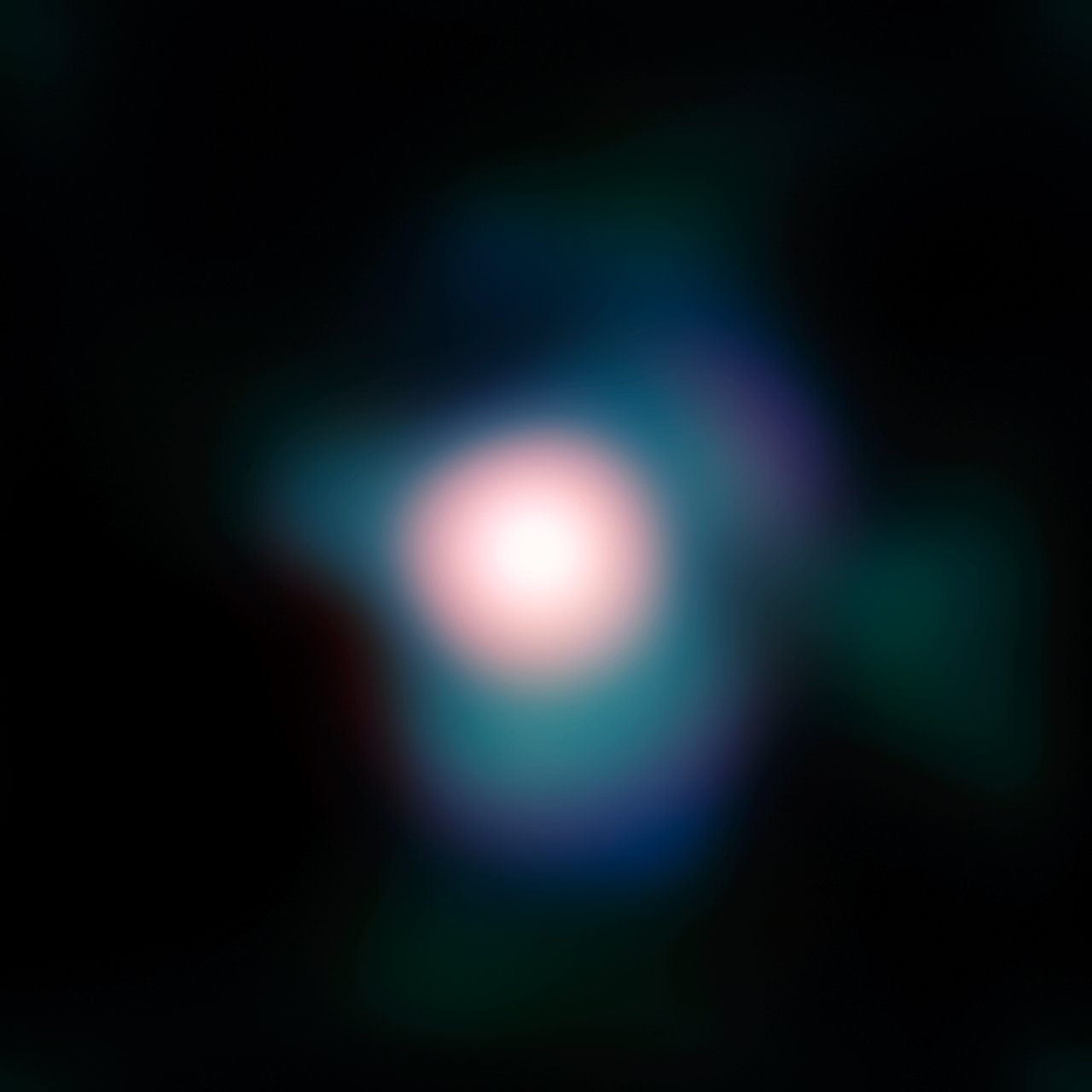
This is the best ever image of Betelgeuse and its asymetric plume of gas that extends up to six times the diameter of the star. For more information read Closest-Ever Look At Betelgeuse Reveals its Fiery Secret | Universe Today.
Larger and further away than we thought
A 2008 study using the Very Large Array of Radio Telescopes determined that Betelgeuse is further from us than previously thought. This also means that Betelgeuse is proportionally larger than previously thought!
Prior to this Burnham's Celestial Handbook, a standard reference text, gave the distance to Betelgeuse as about 520 light years with a diameter ranging from 550 to 920 solar diameters and a mass of about 20 solar masses. Older sources gave it as 427 light years.
The new distance is calculated as 640 light years (although allowance for error gives a range of 595 to 790 light years). Any variation due to error means that Betelgeuse is larger (or smaller) by the same proportion.
The method used to find the distance to Betelgeuse is called the parallax method and involves measuring the apparent movement of a star from Earth at six month intervals using Earths orbit around the Sun to establish the longest possible base line for triangulation. Astronomers measure such distances in units called Parsecs which are then converted to light years (at 3.26 Light Years / Parsec). This only works for stars that are relatively close to us and depends upon our distance to the Sun.
Astronomers often measure the size of stars in angular diameters as this avoids confusion when a distance is revised. Ignoring the fact that Betelgeuse varies in size and using a typical size (angular diameter) of 0.045" we can see that with this new distance the star is very much larger at 925 versus 750 times the size of our Sun.
To put this in perspective, if Betelgeuse replaced our sun, it would swallow everything out to past Jupiter. Because there is a range and because Betelgeuse is variable and swells, Saturn too might be doomed.
Variable Brightness and Size
Betelgeuse is a variable star that dims and brightens over a period of 5.7 years ranging from magnitude 0.2 to 1.2. There is also a lesser cycle of between 150 and 300 days. Observations of Betelgeuse have shown that this dimming and brightening goes hand in hand with physical shrinking and swelling of the star. Betelgeuse can expand by almost 60% in size!
Stranger still, Betelgeuse appears to be different sizes when looked at with different frequencies of the electromagnetic spectrum! In fact, under some wave lengths it's almost twice as large in diameter as in visible light. The image below from 1998 is just beyond the far infra-red and shows the size of the disk in visible light as well as comparing the size to the orbits of Jupiter and Saturn.
Note: the lines showing the orbits of Jupiter and Saturn are based on the older smaller distance - they are too big! Saturn's orbit should run from +/-50 milliarcseconds.
Betelgeuse's enormous volume vastly overwhelms its high mass and results in a photosphere that is so thin that it has been described as a red hot vacuum. The outer layers of the star may be even more interesting consisting of an extended chromosphere and dust clouds that grow and shrink with the star.
Multiple Stars and Companions?
To my knowledge, the question of Betelgeuse as a multiple star system has not been answered. Articles describing this can be found through the AAVSO (American Association of Variable Star Observers) and even though this isn't in the Wikipedia article there are notes in the accompanying discussion page.
The image below clearly shows four companions labeled B through E (Betelgeuse itself is A). Most of these stars have been known since the time of Herschel.
To give some idea of scale, the distance from Betelgeuse to the E star at 175 arcseconds should be about 0.5 light years based on the latest distance estimates.
It's easy to see that these could be overlooked. Unlike well known binary systems, such as Albireo, these companions are quite dim ranging from 11 to almost 15th magnitude. For comparison, if a duplicate of our Sun orbited Betelgeuse it would appear about as bright as the brightest of these stars. And although several star catalogs list Betelgeuse as a multiple star system, Burnham states that it isn't certain if these are just field stars (or if they form a true multiple star system).
Spots!
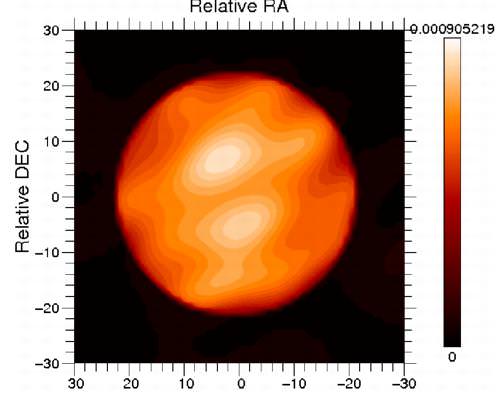
Beteleguese is believed to have massive sunspots that have been apparent in images of the disk. Even the first image taken by the Hubble in 1996 showed evidence of a bright region. Recent images obtained from Infrared Optical Telescope Array (IOTA) interferometer on Mount Hopkins in Arizona and the Paris Observatory (LESIA) show two massive spots. The spots are larger than the distance from the Earth to our Sun!
Credit: Copyright 2010 Haubois / Perrin (LESIA, Observatoire de Paris)
Link Universe Today.
Updates:
- The Curious Case of the Shrinking Star | Universe Today - it seems that Betelgeuse has shrunk 15% since 1993.
- Betelgeuse is shrinking: Supernova or Supernothing | Space Disco - about people jumping to conclusions.
- Closest-Ever Look At Betelgeuse Reveals its Fiery Secret | Universe Today - ESO analysis showing giant gas plumes and gas movement across the surface of the star.
- Unprecedented Images Show Betelgeuse Has Sunspots | Universe Today - near infrared inferometry images show massive sunspots.
- Hot Jupiter Trojans! MOST finds exoasteroids?
- MOST caught on camera!
- Planets and Stars - video - Just how big are they?
- Mang gets a space telescope!
- Mang interviewed in Etobicoke Guardian
- Astronomical distances are .... (well) astronomical
- Orion returns to the evening sky
- Breaking news on NEOSSat
- Wikipedia list of brightest stars
- Wikipedia on Betelgeuse
- Making MOST (A scale model made by a Cub Pack)
- Tipsy Orion (when marketing misses the mark)
I'd like to thank Dr. Jaymie Matthews, the Science Team, Ron Wessels, the Operations Team at MSCI (Microsat Systems Canada Inc. formerly the Space Systems division of Dynacon Inc.) for their cooperation and feedback. I'd also like to thank the MOST team, the University of British Columbia, and the Canadian Space Agency for permission to use their images.
Next Article: How You Could Pilot a Space Telescope (Upside Down)
Labels:
Astronomy,
SpaceExploration
Thursday, January 1, 2009
Project Earthshine!
With the McLaughlin Planetarium closed for more than a decade and the David Dunlap Observatory only closed a few months, it would seem that Southern Ontario is suffering in the area of Astronomy and Space Exploration outreach and education.That may soon be about to change. Please checkout the Earthshine foundation and their mission to to help build and operate a proposed state-of-the-art Planetarium and Space Discovery Centre in Southern Ontario.
Click on the Earthshine logo to check them out.
Related Articles:
Labels:
Astronomy,
SpaceExploration
Wednesday, September 17, 2008
Mang interviewed in Etobicoke Guardian
This week the Etobicoke Guardian has an article on page 3 titled "Twinkle, Twinkle, Dying Star ...". It can be found online as Amateur astronomer gets access to space telescope about my winning one of the My Own Space Telescope proposals to use MOST: Canada's First Space Telescope.
See also: Mang gets a space telescope!
Thanks to Tamara Shephard and Ian Kelso of the Guardian.
See also: Mang gets a space telescope!
Thanks to Tamara Shephard and Ian Kelso of the Guardian.
Labels:
Astronomy,
SpaceExploration,
Telescope
Double Iridium Flare spotted at the 433rd!
Meeting
Last night we had our first meeting of the year with 17 Cubs coming out and a couple that couldn't make it. The majority are returning Cubs from last year, with one transfer and 3 new chums.
One of the orders of business was a badge survey to see where we all were. Several of our Cubs need to get some previously earned badges sewn on. (Hint to Mom's and Dad's - if your Cub does the sewing it counts towards a badge requirement).
Most of the Cubs are within one or two requirements of their Space Exploration badges! If they can design/draw their own space suit or vehicle and bring it in will get many of them there.
Flares
The night was clear but with a lot of light around the Church we wouldn't have much of an opportunity to see constellations, but that wasn't what we came to see. At 8:15pm we stepped outside the Church to see an Iridium Flare.
I'd previously looked up the schedule through the Heavens Above link from the extended clear sky chart on What's Up @ Lloyd Manor Park - Sky Forecast. And at 8:19pm we saw a satellite passing below and to the west of the north star flare. (I love the fact that you can set the alarm on your cell phone on the forecast and it's right on). Surprisingly, about 40 seconds later, we saw a second following satellite flare! (Normally, double flares are due to replacements).
For last nights schedule of Iridium #18, see this. I'm not sure how long these double flares run, but if you're an Iridium watcher you may be able to catch it again.
Bonus
Additionally, our sharp eyed Cubs spotted a "satellite" moving through Cygnus and Lyra toward the north east at 8:24. It turns out to be a Russian Cosmos #1093 rocket booster launched in 1979.
For a track of this rocket booster, see this.
Last night we had our first meeting of the year with 17 Cubs coming out and a couple that couldn't make it. The majority are returning Cubs from last year, with one transfer and 3 new chums.
One of the orders of business was a badge survey to see where we all were. Several of our Cubs need to get some previously earned badges sewn on. (Hint to Mom's and Dad's - if your Cub does the sewing it counts towards a badge requirement).
Most of the Cubs are within one or two requirements of their Space Exploration badges! If they can design/draw their own space suit or vehicle and bring it in will get many of them there.
Flares
The night was clear but with a lot of light around the Church we wouldn't have much of an opportunity to see constellations, but that wasn't what we came to see. At 8:15pm we stepped outside the Church to see an Iridium Flare.
I'd previously looked up the schedule through the Heavens Above link from the extended clear sky chart on What's Up @ Lloyd Manor Park - Sky Forecast. And at 8:19pm we saw a satellite passing below and to the west of the north star flare. (I love the fact that you can set the alarm on your cell phone on the forecast and it's right on). Surprisingly, about 40 seconds later, we saw a second following satellite flare! (Normally, double flares are due to replacements).
For last nights schedule of Iridium #18, see this. I'm not sure how long these double flares run, but if you're an Iridium watcher you may be able to catch it again.
Bonus
Additionally, our sharp eyed Cubs spotted a "satellite" moving through Cygnus and Lyra toward the north east at 8:24. It turns out to be a Russian Cosmos #1093 rocket booster launched in 1979.
For a track of this rocket booster, see this.
Labels:
Astronomy,
Cubs,
SpaceExploration
Thursday, August 28, 2008
Hot Jupiter Trojans! MOST finds exoasteroids?
When putting together Mang gets a space telescope! I found an abstract of a paper at The Science of Most. I haven't read the full paper yet, but if I read this correctly the MOST team may have found a Trojan asteroid swarm accompanying HD 209458b an exoplanet orbiting a sun like star about 150 light years away.
This is especially impressive given that the actual telescope in MOST is smaller than many amateur scopes!
The paper can be found here Searching for asteroids around another star.
I may be missing something but, I've never heard of an exoasteroid discovery before. It never even occurred to me that it they could be detected with current telescopes.
Now why is this not very big news?
Given the conservative title of the article and a quick peek at it, I gather that the results are preliminary but promising. It sounds like they are still sorting out some details like trying to eliminate possible noise.
Still if it isn't conclusive yet, the game is definitely afoot.
Update: A quick check indicates that exosolar asteroids are new. Just not as new as I'd originally thought. Still, they've never made big mainstream news the way exoplanets have.
This is especially impressive given that the actual telescope in MOST is smaller than many amateur scopes!
The paper can be found here Searching for asteroids around another star.
I may be missing something but, I've never heard of an exoasteroid discovery before. It never even occurred to me that it they could be detected with current telescopes.
Now why is this not very big news?
Given the conservative title of the article and a quick peek at it, I gather that the results are preliminary but promising. It sounds like they are still sorting out some details like trying to eliminate possible noise.
Still if it isn't conclusive yet, the game is definitely afoot.
Update: A quick check indicates that exosolar asteroids are new. Just not as new as I'd originally thought. Still, they've never made big mainstream news the way exoplanets have.
Labels:
Astronomy,
CarnivalOfSpace,
SpaceExploration,
Telescope
Wednesday, August 27, 2008
Mang gets a space telescope!
Last year the team responsible for Canada's very successful space telescope, MOST (Microvariability & Oscillations of STars), opened the door to the public to propose stars to be studied (see My Own Space Telescope).
MOST packs a lot of power in a very small package. It has the ability to detect the tiniest variations in the light of other stars and track them over long periods of time. It has been used for astroseismology and to detect planets and maybe even asteroids[1] orbiting other stars (see The Science of Most)! There is even a "singing star" called Eta Bootis.
I picked Betelgeuse (see this NASA Images page on Betelgeuse for more information). It's a celebrity. As one of the largest, brightest and best known stars in our sky, it holds a lot of fascination. All of our Cubs and Scouts know it!
Here are some Betelgeuse facts:
Update: If I read this correctly they may have found a Trojan asteroid swarm around HD 209458b see Searching for asteroids around another star. Why is this not very big news?
Other Related: Astronomical distances are .... (well) astronomical
MOST packs a lot of power in a very small package. It has the ability to detect the tiniest variations in the light of other stars and track them over long periods of time. It has been used for astroseismology and to detect planets and maybe even asteroids[1] orbiting other stars (see The Science of Most)! There is even a "singing star" called Eta Bootis.
- Last year the 433rd Cubs built a scale model of Most (see Making Most).
- Almost unbelievably MOST has been caught on camera !
I picked Betelgeuse (see this NASA Images page on Betelgeuse for more information). It's a celebrity. As one of the largest, brightest and best known stars in our sky, it holds a lot of fascination. All of our Cubs and Scouts know it!
Here are some Betelgeuse facts:
- Betelgeuse is a monster, a Red Supergiant. If Betelgeuse were here, we'd be inside it!
- It pulsates semi-regularly, swelling up and down vast distances (think of the orbits of Mars and Jupiter) over a 5-6 year period.
- It was the first star outside our solar system to have its disk photographed.
- It has had truly massive spots on its face.
- Despite the vast size of Betelgeuse, it weighs less than 30 times our own Sun and has been described as a red hot vacuum (1/10,000th of an atmosphere on average).
- Unlike our own Sun, it's chromosphere extends many times the diamater of its photosphere. Think of the orbit of Neptune!
- It will likely die in a supernova explosion. Possibly in the relatively near future. It's too far away (> 400 LY) and pointed the wrong way to hurt us. But when it does explode, it will likely be brighter than the Moon and possibly visible in the day.
- The now closed McLaughlin Planetarium had a scale model of a number of stars at the base of the stairs going to the theatre dome. The Sun was pea sized about 1/3". Betelgeuse (or a segment of it) was on the floor and over 15' in diameter!
- Our little Sun would not be visible from Betelgeuse!
- It would be easy to believe Betelgeuse is the largest star in our galaxy. It isn't. It's just the best known big star!
- Could it have exoplanets and could we detect them?
- What is the nature of its variability and massive spots?
- Might we get a better idea of its mass, age and when it might explode?
- What might we learn anything of about our own Sun and it's possible fate?
Update: If I read this correctly they may have found a Trojan asteroid swarm around HD 209458b see Searching for asteroids around another star. Why is this not very big news?
Other Related: Astronomical distances are .... (well) astronomical
Labels:
Astronomy,
CarnivalOfSpace,
SpaceExploration,
Telescope
MOST caught on camera!
MOST is a very small package (less than 1 square metre) orbiting constantly near the boundary of night and day (800 km up). Unlike the International Space Station and larger satellites, you'll never see it by eye. And you'll find precious little about it on satellite tracking sites like Heavens Above.
But MOST is not so small that it cannot be seen - if you have the right equipment.
It turns out that a Toronto RASC member, Eric Briggs, photographed MOST passing overhead. He used a special computer controlled telescope about the same power as the large one I take to our camps but with faster optics (f2).
He posted this amazing video on You Tube:
Update: Some IE users are having trouble seeing the embedded video. If you can't see it above, try this link.
MOST is very hard to see early on. It appears almost as a ghost in the center of the video as the scope tracks by stars. Best to look about 4-5 minutes in.
h/t to Dr. Jaymie Matthews for this
But MOST is not so small that it cannot be seen - if you have the right equipment.
It turns out that a Toronto RASC member, Eric Briggs, photographed MOST passing overhead. He used a special computer controlled telescope about the same power as the large one I take to our camps but with faster optics (f2).
He posted this amazing video on You Tube:
Update: Some IE users are having trouble seeing the embedded video. If you can't see it above, try this link.
MOST is very hard to see early on. It appears almost as a ghost in the center of the video as the scope tracks by stars. Best to look about 4-5 minutes in.
h/t to Dr. Jaymie Matthews for this
Labels:
Astronomy,
CarnivalOfSpace,
SpaceExploration,
Telescope
Thursday, July 3, 2008
Carnival of Space #61: Tunguska Edition
Welcome everyone to the 61st Carnival of Space. I am delighted to be your host for this edition of the Carnival marking the 100th Anniversary of the Tunguska Event.
As this is my first time hosting, I also want to welcome you to Mang's Bat Page where a Cub Scout leader takes a strong interest in astronomy, space exploration, cryptography, and why things fail - all hopefully with a Scouting flavour. If you want to know about the name see Why Mang?
I encourage you all to leave comments. Normally this site is moderated, but for the next week I've opened things up. Please keep all comments PG as I have youth readers and I don't want to delete comments (I have no ability to edit them).
Well perhaps not the real cause. So without further ado ... lets get this party started.
First our non-Tunguska submissions ...
From Earth to the Moon and Mars
At Nextbigfuture, Brian Wang reports that the Blackswift Hypersonic program may not get fully funded for the $750 million that it needs, but the program has a lot of interesting technology and innovations for greater efficiency. Read more about The technology of the hypersonic Falcon HTV-3X.
From Centauri Dreams, Paul Gilster, sends us NanoSail-D: Solar Sail Deployment Planned which looks at the upcoming attempt to launch a small solar sail for deployment experiments in space on a modest budget.
At A Babe in the Universe, Louise Riofrio, gives us a peek at Altair. Perhaps the next lunar lander by 2019. And possibly a large step towards a moon base.
From Altair VI, David Portree sends us articles on two early US studies: the first Mars sample return study (1967) and the first lunar outpost resupply study (1992). There are some nice Gemini pics too.
And at Colony Worlds, Darnell Clayton considers that future Martian colonists may need to rely on "solar steam power" technology in Solar Steam To Power Martian Cities? Oh, and there's a video too.
Ian O'Neill at Astroengine considers future Mars colonists in Watch out Phoenix! Don't Scratch the CD! I guess, the receipt will be the least of their problems returning it.
Update: Emily at the Planetary Society has an update on the activities of the Phoenix mission at Mars, up to sol 36. This update contains some amazing amateur-produced panoramas, and some more troubling news about TEGA. Read more in Phoenix sol 36 update: Scraping in Wonderland, next steps for TEGA.
Science!
Over at Starts with a Bang!, Ethan Siegel announces the publication of a paper about Dark Matter in Our Solar System. Congratulations Ethan!
Mike Simonsen at Simostronomy looks at Dusty TOADs a rare class of White Dwarves with a bit of a temper. Please pass the sun screen folks.
From the Orbiting Frog, Rob sends us plans on how to make your own spectrometer! (with everyday household items no less). Pity, for once his science experiments don't involve food or drink. It's okay Rob, the Cub Scouts will forgive you :)
Entertainment, Photography, and Art
Moving down-under, Ian Musgrave at Astroblog has some photos and animation of The ISS, Mars, Saturn and Crux. (Hey Ian, I could use some southern feedback on Navigation Without Compass or GPS).
At Out of the Cradle, Ken Murphy our Lunar Librarian, provides a nice of overview and update on Japanese space comics (Manga) and cartoons (Anime).
Music of the Spheres discusses the new Pixar movie WALL-E. Should we fear science and technology, or embrace it? The answer from WALL-E the robot in 2700: yes! Read more at WALL-E: The Trash Route to Space Colonies.
At the Martian Chronicles, Ryan Anderson looks at the new Astrobiology related computer game Spore and considers some of the science in the game.
Insight
At Cumbrian Sky, Stuart Atkinson takes a personal reflection on his enthusiasm for astronomy, outreach, and those who do and don't get it in Woah... I know Astronomy.... Well worth a read.
Over at Artsnova Art Gallery, Jim Plaxco takes on the The Religion of the Face on Mars and talks about why people want to see a face.
Rob from Orbiting Frog nominated Stuart's article at the Astronomy Blog titled Changes to ESA?
Bruce Cordell at 21st Century Waves writes "10 Reasons Why China is Good for Space" and looks at some economic reasons why the decade from 2015 will be interesting for space exploration and development.
From Free Space blogs at Discovery News, Irene Klotz writes about Twittering spacecraft and blogs. Phoenix twitters. And now, apparently, so does her blog.
History & Conservation
Robert Pearlman at collectSPACE has contributed an editorial to Discovery Channel's space blogs about saving the bricks recently blasted out of the Pad 39A flame trench in If these Walls could Talk. I'd sure like to buy one.
Update: Todd Flowerday at Catholic Sensibility reflects on Satellite Imagination: the Herschel years. It seems a lot of early astronomers had some rather large blind spots. But not Herschel.
Tunguska
Yikes Fraser! I was sure there would be a raft of articles submitted on Tunguska. So following the motto of being prepared, I took the liberty of writing my own. Please enjoy reading Tunguska's Legacy.
I'd also like to nominate the following articles.
Congratulations to the Bad Astronomer on his move to Discovery blogs.
Thanks to Fraser for letting me fill in this week as the Carnival guest host.
Finally, thanks to everyone for reading. Please take some time and explore the Bat Page, fill in the guest book or contact me.
Update: Oops and I almost forgot NEOSSat
Music of the Spheres posted Don't Blame Canada and Universe Today posted Canada to build World's First Asteroid-hunting Satellite.
Until next week ...
---
Carnival of Space Index @ Universe Today
Previous: Carnival of Space No. 60 @ Slacker Astronomy
Next: Carnival of Space #62 - The Image Extravaganza! @ Space Disco
As this is my first time hosting, I also want to welcome you to Mang's Bat Page where a Cub Scout leader takes a strong interest in astronomy, space exploration, cryptography, and why things fail - all hopefully with a Scouting flavour. If you want to know about the name see Why Mang?
I encourage you all to leave comments. Normally this site is moderated, but for the next week I've opened things up. Please keep all comments PG as I have youth readers and I don't want to delete comments (I have no ability to edit them).
Thanks to my friend Richard for the Tesla death ray photo
and not electrocuting anyone in the process.
(BTW. the spark to the grounding rod on the left was over 8 feet!)

So let's explore the real cause of the Tunguska blast ...and not electrocuting anyone in the process.
(BTW. the spark to the grounding rod on the left was over 8 feet!)

Well perhaps not the real cause. So without further ado ... lets get this party started.
First our non-Tunguska submissions ...
From Earth to the Moon and Mars
At Nextbigfuture, Brian Wang reports that the Blackswift Hypersonic program may not get fully funded for the $750 million that it needs, but the program has a lot of interesting technology and innovations for greater efficiency. Read more about The technology of the hypersonic Falcon HTV-3X.
From Centauri Dreams, Paul Gilster, sends us NanoSail-D: Solar Sail Deployment Planned which looks at the upcoming attempt to launch a small solar sail for deployment experiments in space on a modest budget.
At A Babe in the Universe, Louise Riofrio, gives us a peek at Altair. Perhaps the next lunar lander by 2019. And possibly a large step towards a moon base.
From Altair VI, David Portree sends us articles on two early US studies: the first Mars sample return study (1967) and the first lunar outpost resupply study (1992). There are some nice Gemini pics too.
And at Colony Worlds, Darnell Clayton considers that future Martian colonists may need to rely on "solar steam power" technology in Solar Steam To Power Martian Cities? Oh, and there's a video too.
Ian O'Neill at Astroengine considers future Mars colonists in Watch out Phoenix! Don't Scratch the CD! I guess, the receipt will be the least of their problems returning it.
Update: Emily at the Planetary Society has an update on the activities of the Phoenix mission at Mars, up to sol 36. This update contains some amazing amateur-produced panoramas, and some more troubling news about TEGA. Read more in Phoenix sol 36 update: Scraping in Wonderland, next steps for TEGA.
Science!
Over at Starts with a Bang!, Ethan Siegel announces the publication of a paper about Dark Matter in Our Solar System. Congratulations Ethan!
Mike Simonsen at Simostronomy looks at Dusty TOADs a rare class of White Dwarves with a bit of a temper. Please pass the sun screen folks.
From the Orbiting Frog, Rob sends us plans on how to make your own spectrometer! (with everyday household items no less). Pity, for once his science experiments don't involve food or drink. It's okay Rob, the Cub Scouts will forgive you :)
Entertainment, Photography, and Art
Moving down-under, Ian Musgrave at Astroblog has some photos and animation of The ISS, Mars, Saturn and Crux. (Hey Ian, I could use some southern feedback on Navigation Without Compass or GPS).
At Out of the Cradle, Ken Murphy our Lunar Librarian, provides a nice of overview and update on Japanese space comics (Manga) and cartoons (Anime).
Music of the Spheres discusses the new Pixar movie WALL-E. Should we fear science and technology, or embrace it? The answer from WALL-E the robot in 2700: yes! Read more at WALL-E: The Trash Route to Space Colonies.
At the Martian Chronicles, Ryan Anderson looks at the new Astrobiology related computer game Spore and considers some of the science in the game.
Insight
At Cumbrian Sky, Stuart Atkinson takes a personal reflection on his enthusiasm for astronomy, outreach, and those who do and don't get it in Woah... I know Astronomy.... Well worth a read.
Over at Artsnova Art Gallery, Jim Plaxco takes on the The Religion of the Face on Mars and talks about why people want to see a face.
Rob from Orbiting Frog nominated Stuart's article at the Astronomy Blog titled Changes to ESA?
Bruce Cordell at 21st Century Waves writes "10 Reasons Why China is Good for Space" and looks at some economic reasons why the decade from 2015 will be interesting for space exploration and development.
From Free Space blogs at Discovery News, Irene Klotz writes about Twittering spacecraft and blogs. Phoenix twitters. And now, apparently, so does her blog.
History & Conservation
Robert Pearlman at collectSPACE has contributed an editorial to Discovery Channel's space blogs about saving the bricks recently blasted out of the Pad 39A flame trench in If these Walls could Talk. I'd sure like to buy one.
Update: Todd Flowerday at Catholic Sensibility reflects on Satellite Imagination: the Herschel years. It seems a lot of early astronomers had some rather large blind spots. But not Herschel.
Tunguska
Yikes Fraser! I was sure there would be a raft of articles submitted on Tunguska. So following the motto of being prepared, I took the liberty of writing my own. Please enjoy reading Tunguska's Legacy.
I'd also like to nominate the following articles.
- Tunguska, One Century Later - Astroprof
- 100th Anniversary of a Cosmic Warning - Centauri Dreams
- 100 years ago today: KABLAM!!!!! - The Bad Astronomer
Congratulations to the Bad Astronomer on his move to Discovery blogs.
Thanks to Fraser for letting me fill in this week as the Carnival guest host.
Finally, thanks to everyone for reading. Please take some time and explore the Bat Page, fill in the guest book or contact me.
Update: Oops and I almost forgot NEOSSat
Music of the Spheres posted Don't Blame Canada and Universe Today posted Canada to build World's First Asteroid-hunting Satellite.
Until next week ...
---
Carnival of Space Index @ Universe Today
Previous: Carnival of Space No. 60 @ Slacker Astronomy
Next: Carnival of Space #62 - The Image Extravaganza! @ Space Disco
Labels:
Astronomy,
CarnivalOfSpace,
Science,
SpaceExploration
Tuesday, July 1, 2008
Tunguska's Legacy
One hundred years ago today[1] there was a very large explosion over the lower Tunguska river in Siberia[2]. Known as the Tunguska event, the explosion is estimated to have been equivalent to a blast of at least 5 million tons of TNT and felled over 80 million trees. The cause was a mystery for decades. Evidence of Nickel and Iridium have been found near the site which supports theories of a meteor impact or air burst. Eyewitnesses told their stories to investigators years later. To date, no crater or fragments have been found.
Unaware of our dangerous neighbourhood
For millennia people have lived in ignorance of the space around our planet. Comets were thought to be bad omens and portenders of catastrophe. Yet, asteroids and meteoroids whizzed by us unnoticed. What we do notice are the frequent meteor showers caused by small particles burning up in the atmosphere and occasional fireballs and small explosions caused by larger rocks.
Very occasionally one of these larger rocks would get too close and explode low in the atmosphere or impact the planet leaving devastation and craters. And on very rare occasions there are devastating explosions. The best known of these was about 65 million years ago and is credited with killing off the dinosaurs.
It has only been very recently that we have recognized impact sites for what they are. The earth, weather, and time are very good at obliterating the evidence. Even the origin of the famous Barringer Crater in Arizona was controversial up until 1960! And the Barringer crater looks like it was moved from the moon to the dessert.
Tunguska didn't leave a crater and wasn't investigated until years later. It certainly isn't as obvious as Barringer or other sites. While the meteor explosion is the leading theory, there is an alternate one based on the idea of a explosive volcanic gases (a micro-Verneshot). There are also a large number of bizarre and wild ideas as to its' origin.
The legacy of Tunguska and other impacts has been to raise awareness amongst scientists, policy makers, and the public that impacts from meteors, comets, and asteroids do happen and that action can and should be taken to protect people and the environment.
What can we Do?
If we are unlucky enough to have a really large rock bearing down on us and about to strike then there is not much we can do. But these are exceptionally rare events and we should have lots of time to act. It's is certainly in our best interest to be prepared to do something to prevent this kind of event if we can.
1. Don't Panic!
While the thought of multi-megaton impacts sounds pretty scary, its important not to over react. How does this all stack up?
2. Size the Risk
Consider, if Tunguska sized events happen once every hundred years, then there will have been more that 1/2 million of them since the dinosaurs died out. If they happened every 1000 years, that's still over 50,000 strikes. There is no historical evidence indicating similar strikes in written history[5] which covers the last 6000 years or so.
How do we do this? By studying both the sky and the Earth.
3. Prepare for Action
Advance warning will let us focus on the dangerous rocks and give us the years needed to prepare. It will also give us techniques that will be more effective and far less dramatic than throwing nuclear weapons around.
Research is already underway around the world on things that can be done. And a broad set of tools is being proposed to deal with the risk. They range from
Some other Tunguska anniversary posts
Oh, and back at Tunguska
An Italian research team may have found evidence of an impact body that survived the air burst, here.
-----
[1] The explosion occurred at 7:14am local time on June 17th, 1908 in the Julian Calendar in use there at the time. This was June 30th on western calendars. Adjusting for time zones the blast was at 7:14PM EST June 29th. For a versatile date converter capable of converting between many calendars see here. My original notes for this were based on an old Wikipedia entry with an incorrect date and was going to publish this on June 30th on the Julian calendar - so I'm now late beaten to the punch :(
[2] The location, given as 60°55' N, 101°57'E, is pretty remote as you can see here.
[3] I've written about asteroid near misses before, here.
[4] I've also written about fear mongers before, here.
[5] There is some speculation that the Biblical tale of Lot's wife may relate to such a strike. But it seems designed to sell a book. See here, and here. A very strong critique (with some mild bad language) here. See [4] above.
Unaware of our dangerous neighbourhood
For millennia people have lived in ignorance of the space around our planet. Comets were thought to be bad omens and portenders of catastrophe. Yet, asteroids and meteoroids whizzed by us unnoticed. What we do notice are the frequent meteor showers caused by small particles burning up in the atmosphere and occasional fireballs and small explosions caused by larger rocks.
Very occasionally one of these larger rocks would get too close and explode low in the atmosphere or impact the planet leaving devastation and craters. And on very rare occasions there are devastating explosions. The best known of these was about 65 million years ago and is credited with killing off the dinosaurs.
It has only been very recently that we have recognized impact sites for what they are. The earth, weather, and time are very good at obliterating the evidence. Even the origin of the famous Barringer Crater in Arizona was controversial up until 1960! And the Barringer crater looks like it was moved from the moon to the dessert.
Tunguska didn't leave a crater and wasn't investigated until years later. It certainly isn't as obvious as Barringer or other sites. While the meteor explosion is the leading theory, there is an alternate one based on the idea of a explosive volcanic gases (a micro-Verneshot). There are also a large number of bizarre and wild ideas as to its' origin.
The legacy of Tunguska and other impacts has been to raise awareness amongst scientists, policy makers, and the public that impacts from meteors, comets, and asteroids do happen and that action can and should be taken to protect people and the environment.
What can we Do?
If we are unlucky enough to have a really large rock bearing down on us and about to strike then there is not much we can do. But these are exceptionally rare events and we should have lots of time to act. It's is certainly in our best interest to be prepared to do something to prevent this kind of event if we can.
1. Don't Panic!
While the thought of multi-megaton impacts sounds pretty scary, its important not to over react. How does this all stack up?
- Small impacts and near misses happen all the time. [3][4]
- Big impacts, like Tunguska, are uncommon. When they do happen, they are likely to be in remote areas or over oceans.
- Really massive impacts, like the one the killed off the dinosaurs, are incredibly rare. So rare, it's almost impossible to get a real feeling for the time-scale even though we can measure it.
2. Size the Risk
Consider, if Tunguska sized events happen once every hundred years, then there will have been more that 1/2 million of them since the dinosaurs died out. If they happened every 1000 years, that's still over 50,000 strikes. There is no historical evidence indicating similar strikes in written history[5] which covers the last 6000 years or so.
How do we do this? By studying both the sky and the Earth.
- Geologists have been getting very good at finding impact sites on Earth. There is a online impact database, here (a Canadian contribution). This can tell us a lot about what reached the ground.
- There are all sky camera networks to detect fireballs from meteors, here and here.
- Recent work has detected Explosions on the Moon which can tell us a bit about how dangerous our neighbourhood is by watching the impact on a body unprotected by an atmosphere.
- The US Congress has mandated and funded an effort to detect, catalogue, and track any really catastrophically dangerous asteroids. This effort is also detecting a lot of smaller rocks including Tunguska sized meteoroids, as well as comets.
- Canada is launching a micro-satellite called Neossat to detect and help track Near Earth Objects. See Don't Blame Canada.
3. Prepare for Action
Advance warning will let us focus on the dangerous rocks and give us the years needed to prepare. It will also give us techniques that will be more effective and far less dramatic than throwing nuclear weapons around.
Research is already underway around the world on things that can be done. And a broad set of tools is being proposed to deal with the risk. They range from
- radio tagging an asteroid to better understand it's orbit
- painting one so that years of Sunlight alters its orbit for us.
- nudging one using a space tug
- 99942 Apophis is about 270 m and will come very close in 2029 with a possible impact in 2036. As measurements have improved the likelihood of an impact has been reduced and is now considered unlikely
- 1950DA is about 1.4 km and is a risk to impact in the year 2880
- 2007 VK184 is a 130 m rock of most concern right now with a chance of impact in 2048
- The Planetary Society's Apophis competition, here.
- B612 who what to alter an asteroids orbit by 2015, here.*
- US Bill supporting a mission to radio tag Apophis, here.*
- A Russian project to tag Apophis, here.*
Some other Tunguska anniversary posts
- Tunguska, One Century Later - Astroprof
- 100th Anniversary of a Cosmic Warning - Centauri Dreams
- 100 years ago today: KABLAM!!!!! - The Bad Astronomer
Oh, and back at Tunguska
An Italian research team may have found evidence of an impact body that survived the air burst, here.
-----
[1] The explosion occurred at 7:14am local time on June 17th, 1908 in the Julian Calendar in use there at the time. This was June 30th on western calendars. Adjusting for time zones the blast was at 7:14PM EST June 29th. For a versatile date converter capable of converting between many calendars see here. My original notes for this were based on an old Wikipedia entry with an incorrect date and was going to publish this on June 30th on the Julian calendar - so I'm now late beaten to the punch :(
[2] The location, given as 60°55' N, 101°57'E, is pretty remote as you can see here.
[3] I've written about asteroid near misses before, here.
[4] I've also written about fear mongers before, here.
[5] There is some speculation that the Biblical tale of Lot's wife may relate to such a strike. But it seems designed to sell a book. See here, and here. A very strong critique (with some mild bad language) here. See [4] above.
Labels:
Astronomy,
CarnivalOfSpace,
Environment,
SpaceExploration
Thursday, June 26, 2008
Breaking news on NEOSSat
Dynacon of Canada is putting up another micro-satellite!
See the project website here. And today's press release here.
NEOSSat will fly a compact package in a 700 km polar orbit tracking and detecting near Earth objects including other satellites and asteroids. It has the capacity to image hundreds of objects a day on exposures collecting only a few photons per second.
NEOSSat was developed by the same people that brought you MOST, see here (okay - not the Cubs but the real MOST).
BTW. You can include your name and have it sent into space with NEOSSat, here.
(I know it's over used but I always wanted to write breaking news at least once:)
See the project website here. And today's press release here.
NEOSSat will fly a compact package in a 700 km polar orbit tracking and detecting near Earth objects including other satellites and asteroids. It has the capacity to image hundreds of objects a day on exposures collecting only a few photons per second.
NEOSSat was developed by the same people that brought you MOST, see here (okay - not the Cubs but the real MOST).
BTW. You can include your name and have it sent into space with NEOSSat, here.
(I know it's over used but I always wanted to write breaking news at least once:)
Labels:
Astronomy,
SpaceExploration
Monday, May 5, 2008
The 433rd goes to the Moon!
Yes, you heard it here first. It's true the 433rd is going to the Moon! Pack your bags, we leave later this year aboard an Atlas V 401 rocket. The trip out will take about four days and we can expect at least a one year stay. You may want to think about a few extra supplies because a lot of recent missions have run well into overtime.
How can a whole Cub pack go to the Moon you ask? Skeptical? Want proof? I don't blame you. Well here it is:

Just in case you want to send someone to the Moon, you can apply here.
If you want more information on the Lunar Reconnaissance Orbiter (LRO), look here. The LRO packs a lot of science and a high resolution camera too. It should be fascinating. And unlike other space exploration missions, we won't have to wait for years for results!
BTW. Has any one seen Alice Kramden's name on the passenger list :)
Update: It seems there is another opportunity to get your name into space with the Kepler Space Telescope that will be looking for exoplanets. For this you need to write a short summary about why the project is important. Perhaps we have another Cub Space Exploration project. For more information see here and here. For the entry see this.
How can a whole Cub pack go to the Moon you ask? Skeptical? Want proof? I don't blame you. Well here it is:
Just in case you want to send someone to the Moon, you can apply here.
If you want more information on the Lunar Reconnaissance Orbiter (LRO), look here. The LRO packs a lot of science and a high resolution camera too. It should be fascinating. And unlike other space exploration missions, we won't have to wait for years for results!
BTW. Has any one seen Alice Kramden's name on the passenger list :)
Update: It seems there is another opportunity to get your name into space with the Kepler Space Telescope that will be looking for exoplanets. For this you need to write a short summary about why the project is important. Perhaps we have another Cub Space Exploration project. For more information see here and here. For the entry see this.
Labels:
Astronomy,
SpaceExploration
Wednesday, March 26, 2008
Making MOST

As part of our Space Exploration Badge we built a full scale model of a satellite! Here are some pictures of our model.
Canada and Canadians have a history of innovation and success in space exploration. From Alouette 1 to the Canadarm and Canadarm2 used aboard the Space Shuttle and International Space Station. By 2006, Canada had over 33 payloads in orbit. One of these is a tiny observatory called Microvariability & Oscillations of STars (MOST) that is making a big splash in the field of astronomy.
Most is a micro-satellite, about the size of a large suitcase, that was launched by Canada on an Russian rocket in 2003. Launched on a modest (for space exploration) budget, MOST has been called the Humble Space Telescope in reference to its much larger and more expensive predecessor the Hubble.
MOST orbits the earth from pole to pole in perpetual darkness and can keep its cameras focused on stars for almost two months! Because it can pick up small variations in light from the stars it observes, MOST can be used to study planets orbiting other stars and variations in the star's atmosphere (a bit like studying earthquakes). MOST hopes to answer questions about how the Sun may evolve and even how stars contributed to the formation of solar systems.
Expected to operate for about one year, it's still going. In fact, the science team has opened up to the public to propose observing targets through the My Own Space Telescope project!
MOST is unusual for a space telescope in that it uses an unusual lens design. The Fabry microlens array spreads light from target stars over a large number of pixels to achieve high resolutions.
The 433rd has contributed too. Mitchell's dad is part of the operations team, Mang has proposed a couple of targets. Here's a chart showing the parts of the sky MOST can see and some of the official candidate and selected targets.
The chart shows the sky mapped out against the coordinates used by astronomers. The x-axis is the Right Ascension (in hours) and the y-axis is the Declination (in degrees).
There are three zones that are important to MOST. The CVZ (Continuous Viewing Zone) is where MOST can keep itself focused for up to about 60 days at a time! There are two SS (Sun Sensor) zones. Targets within the SS zones represent the extreme range of the telescope and can be focused on for shorter time periods. If you are really interested in a star in the SS zones, one trick is to pick a second star and switch between the two. These are called "switch targets".
These targets are all taken from the official web site for MOST. One thing that may be of interest is that some of the candidate stars were chosen before the operational parameters of MOST were well understood. If you look, you will see candidates well outside the SS zones.
This particular chart shows two stars that I proposed for observation. One is a switch target. Can you figure out what they are? And why I picked them?
Another surprise for me was that I could actually get Excel to produce a chart like this!
More information on MOST can be found at
- Wikipedia
- The Canadian Space Agency, and Most @ the CSA.
Labels:
Astronomy,
Badgework,
CarnivalOfSpace,
Cubs,
SpaceExploration,
Telescope
Monday, March 10, 2008
Astronomical distances are .... (well) astronomical
How can someone begin to describe astronomical distances?
We sometimes use fancy compound terms like outer space, deep space, interstellar space, and intergalactic space.
You can use humour to make your point, like Douglas Adams in the The Hitchhikers Guide to the Galaxy:
Think of the Earth as a shiny blue marble (standard marbles are 1.25 cm or 1/2" in diameter - smaller than the one in the photo). Below are some approximate comparable scale sizes for objects /distances in our solar system:
Wait for it! Still using our marble for Earth, the Moon would be 0.75 m or 29" away. Or about an adults' arms length. Below are the approximate distances of things from the Sun using the same scale (I'll give up on Imperial measures here):
Now if you wanted to place these to scale and allow space for the full orbits of all the planets and Pluto (it was demoted to a dwarf planet), the Sun would need to be in Mel Lastman Square in North York at the center of a 28km circle running from Lake Ontario to north of the David Dunlap Observatory in Richmond Hill!
I'll stop now before my head hurts trying to visualize all of this in terms of our little blue marble.
Astronomical distances operate on levels. Just when you think you've gotten used to one of them, you'll see another and be humbled all over again.
We sometimes use fancy compound terms like outer space, deep space, interstellar space, and intergalactic space.
Image used with permission of Jim Boles.

You can be factual like NASA's page on cosmic distances or Wikipedia's page on astronomical distances.
You can use humour to make your point, like Douglas Adams in the The Hitchhikers Guide to the Galaxy:
Space is big. Really big. You just won't believe how vastly hugely mind-bogglingly big it is.You can even be darkly poetic, like Michael Moorecock's "Dark Corridor" introduction to Hawkwind's "Space is Deep":
Space is infinite, it is darkBut none of these help you visualize how big space is!
Space is neutral, it is cold
Stars occupy minute areas of space
They are clustered a few billion here
And a few billion there
As if seeking consolation in numbers
Think of the Earth as a shiny blue marble (standard marbles are 1.25 cm or 1/2" in diameter - smaller than the one in the photo). Below are some approximate comparable scale sizes for objects /distances in our solar system:
- The Moon - 3.5mm or 0.13"
- Mercury - 5mm or 0.2"
- Mars - 7mm or 0.37" - a chickpea
- Venus - another marble (a bit smaller than Earth)
- Low Earth Orbit Satellites - basically the same size as the marble
- Uranus -5 cm or 2" - an orange
- Neptune - another orange (a bit smaller than Uranus)
- Communications satellites (geosynchronous) - 8.25 cm or 3.25" - a hockey puck
- Saturn - 12 cm or 4.75" - grapefruit
- Jupiter - 14 cm or 5.5" - a slightly bigger grapefruit
- Saturn's visible rings - 26.8 cm or 10.5" - an old LP record
- The Sun - 1.36 m or 54" - a small weather balloon or large exercise ball
Wait for it! Still using our marble for Earth, the Moon would be 0.75 m or 29" away. Or about an adults' arms length. Below are the approximate distances of things from the Sun using the same scale (I'll give up on Imperial measures here):
- Mercury - 136 m - a bit larger than a football field
- Venus - 213 m
- Earth - 293 m - a bit shorter than the Eiffel Tower
- Mars - 488 m - a bit shorter than the CN Tower
- Jupiter - 1.6 km
- Saturn - 3 km
- Uranus - 6 km
- Neptune - 9 km
- Pluto - 14 km at its' farthest
Now if you wanted to place these to scale and allow space for the full orbits of all the planets and Pluto (it was demoted to a dwarf planet), the Sun would need to be in Mel Lastman Square in North York at the center of a 28km circle running from Lake Ontario to north of the David Dunlap Observatory in Richmond Hill!
If you're wondering what that looks like, take a look at this map of the Solar System in Toronto.And it gets worse:
- Proxima Centauri the nearest star at around 4.2 light years would be 77,000 km away from our marble. On scale, the marble is about 1/5 of the way to the moon!
- Betelgeuse a red supergiant about 430 light years away would be 7,883,333 km away. On our scale, that's about 1/8 of the way to Mars at it's closest or about 1/20th the distance to our Sun.
- The Milky way galaxy is about 100,000 light years across. So our marble is now about 1.8 billion km away or outside the orbit of Saturn.
I'll stop now before my head hurts trying to visualize all of this in terms of our little blue marble.
Astronomical distances operate on levels. Just when you think you've gotten used to one of them, you'll see another and be humbled all over again.
Labels:
Astronomy,
CarnivalOfSpace,
SpaceExploration
Subscribe to:
Posts (Atom)


WallyPacholka-750wp.jpg)