Showing posts with label Badgework. Show all posts

Friday, July 24, 2009

UK Astronomy Badge

Stumble Upon Toolbar
A few weeks back I received my second exchange in the The Great Astronomers Badge Swap.

The Astronomer's Badge from the 12th Winchester Cubs in the UK (Winchester District).

This is a great example of how to make earning a badge fun and shows a creative way to overcome the challenges of the UK's famously cloudy skies. We face similar challenges here in Toronto during the fall and winter.

The requirements for this badge are:
  1. Make a model or draw a simple diagram of the solar system.
  2. Explain the difference between a planet and a star.
  3. Identify three constellations.
  4. Find out about and present some information on the two of the following: Planets, Comets, the Northern Lights, The Sun, Eclipses,Meteorites, Black holes, The Moon, Light years, Space exploration or any other space related subject.
  5. Observe the moon, if possible using binoculars or a telescope. Describe some of its features.
  6. Know how to locate and identify the Pole star or Southern Star. Know how explorers used it to navigate and plot courses.
Their approach:
  1. They played a simple relay game where the cubs had to put the planets in the correct order from the sun. Then we made 3D models of the planets to hang up in their scout hut. They discussed how far apart to hang them to maintain scale. They thought Jupiter would have ended up about 100km away from the hut!
  2. Each of the cubs explained the difference between stars and planets and gave an example. It was interesting to see how many different correct answers they could give!
  3. With lots of cloudy nights their opportunities to actually observe the night sky were limited. They ended up constructing representations of constellations using candles and tin cans with holes. The Cubs were challenged to identify the constellations shown. They talked about some of the meanings behind the names for constellations.
  4. Each cub came up with different information about objects in space. They also played a true/false game with some facts.
  5. The Cubs did this at home. Drawing a picture or writing about what they saw. One even wrote a rather good poem!
  6. The Cubs practised finding north. Everyone drew a diagram at home to illustrate it. They also visited a local hands-on science centre, and saw some of the shows in the planetarium which the everyone really enjoyed.Badges were presented the day of the outing.
Thanks to Scouter Emma (Riki-Tiki-Tava)!

Please click on the BadgeSwap label below to see other related badges and entries.

Saturday, May 2, 2009

Space badge resource for Girls and Boys

Stumble Upon Toolbar
Ken Murphy over at Out of the Cradle wrote a piece on Girl Scout space badges in Scouting the Moon.  The article also has some references to US Boy Scout Space Exploration merit badge and the interesting online resource meritbadge.org.

(See what you can find when you read Carnival of Space, h/t to Issue #101)

Tuesday, October 21, 2008

Skies Badge - South Africa

Stumble Upon Toolbar

Here are the requirements:

This week the I received my first exchange in the The Great Astronomers Badge Swap.

The Skies Badge from the 9th Benoni Cubs in South Africa.

  1. Identify TWO constellations and the Southern Cross
  2. Make a pinhole planetarium and show THREE constellations
  3. Identify FOUR cloud types
  4. Visit a planetarium or spot a satelite and record the time of sighting and its path across the sky.
My thanks to Akela Joy!

Please click on the BadgeSwap label below to see other related badges and entries.

Monday, September 29, 2008

Scout Scarves, 100th post

Stumble Upon Toolbar
For my 100th post I wanted to talk about something at the core of Scouting. The humble but ever so useful neckerchief seemed a perfect choice.

(The 433rd's colours are featured in the headline image of this blog. Our web site has more details on Uniforms & Badges under each section. For Cubs see here. )

Scouts are widely recognized by their uniform and the colorful neck wear. Neckerchiefs and Woggles (or slides) identify Scouting groups and roles. Go to any large Scouting event and you'll see a sea of coloured neckerchiefs.

While many people don't give Scout scarves much of a thought, they are very practical and have a large number of uses. How many uses can you think of?

The most obvious use is identification. Each groups colours are more or less unique. I've heard that some Scouting organizations register their colors centrally. I know the 9th Benoni in South Africa (see Linking with the 9th Benoni Cubs) made a minor adjustment to their colours to avoid a conflict with a group in Germany. While I know there are local groups with colours that are similar, I'm not certain if Scouts Canada maintains the same degree of uniqueness. Also, the Boy Scouts of America have some different neckerchief traditions (see here).

Woggles (aside from providing quick release) identify the section or role of the wearer. Each section has a colour: red for Rovers, light blue for Venturers, green for Scouts, yellow for Cubs, and brown on blue for Beavers. Leaders who have completed the Wood Badge Part 1 have a brown woven turks head woggle. And those completing the Wood Badge Part 2 get the special Gilwell neckerchief and wooden beads (See Wikipedia on the Wood Badge).

Another important use is first aid. Scout Neckerchiefs are intended to be used as triangular bandages and slings. This point was reinforced at our last swim up camp when one of our Cubs broke his arm. When we brought him to the hospital in Midland one of the staff there commented that they had never seen such interesting and colourful bandages!

Other obvious uses include blindfolds and armbands (for games), masks, and signals.

Below is a list of over 40 uses taken form the Pinetreeweb Scouting web site. Some of the uses may overlap a bit but the list is still impressive. For the full list and more background information please read Pinetree web's Neckerchief article.

  1. As an International Morse signal flag.
  2. For sending messages by Semaphore code.
  3. In knot-tying practice.
  4. For Troop and Patrol identification.
  5. As a reminder of the Scout Good Turn, (single knot).
  6. As indication that wearer is not a Cadet, but a Scout.
  7. As a substitute for a belt.
  8. As a shoulder mat.
  9. As a smoke mask.
  10. As a blindfold for Scout games.
  11. As a dressing for a burned face and neck.
  12. As a sweat band for confining the hair.
  13. For identifying contesting teams.
  14. As a swatter in playing games.
  15. In the three-legged race, to tie legs together.
  16. In games requiring contestants to be hobbled.
  17. In game called "Badger Pulling," to make binder for heads.
  18. As a night cap or ear protector.
  19. As a muffler for storm or blizzard.
  20. As a cover for a pail of water.
  21. As a loin cloth or bathing trunks.
  22. As a triangular cap bandage.
  23. As a napkin.
  24. As an apron.
  25. As a table cloth.
  26. As a dust cloth or cover.
  27. As a "Hobo" bag.
  28. For a tump line to carry a load.
  29. To lash poles or staves together.
  30. As a smoke signal.
  31. As a red flag on projecting end of load.
  32. As a patch for a canoe, when properly treated.
  33. As caulking for a leaky boat, when properly treated.
  34. For distress signal, lighted for a "flare."
  35. As a pad for the head in carrying heavy loads and wherever needed to prevent chafing.
  36. As a padded glove for the hand, to prevent blisters.
  37. As a blindfold for rescuing a horse from fire.
  38. To pad portions of harness to prevent chafing.
  39. To tie up square packages.
  40. For fastening ends of the blanket roll.
  41. For making life line or guard rope.
  42. For making rope ladder.
  43. For making boat sail.
  44. For making emergency clothing

Originally the 433rd had a tartan scarf. When I was a Cub, I was part of the (now defunct) 16th Humber West which also had a tartan scarf. Then it was common for Canadian groups to use unique tartans for their scarves. Tartans provide an almost infinite variety for group colours. Tartans are also interesting both to weavers and mathematically[1]. Unfortunately, difficulty in getting certain tartans has caused many groups to move away from them.

I'd like to dedicate this article to Colin (one of our cubs) who knows first hand the value of a neckerchief.
-----
[1] . Professor Ralph Griswold of the University of Arizona investigated "Digital Weaving" in an IEEE paper and a series of articles in the Icon Analyst beginning at issues 53 through 66.

Tuesday, September 23, 2008

DDO Astronomers renew outreach program - Your Real Sky

Stumble Upon Toolbar
While the David Dunlop Observatory is now closed, two of the astronomers that ran the public outreach program for schools, Scouting, and Guide groups will continue to offer youth focused astronomy programs near the site of the old observatory.

Dr's Tuba Koktay and Ian Shelton have started a new night time Scout and Guide program for the fall of 2008 at Observatory Park and the 16th Avenue Public School in Richmond Hill. Additionally, they have a daytime program for schools.

The program called "Your Real Sky" covers finding your way about the nighttime sky, learning about constellations and the wonders of the nighttime sky, lots of time for questions, and badge requirements.

On clear nights, there will be outdoor observing by eye, binocular, and small telescope. On cloudy nights, they can simulate the nighttime sky in their classroom.

For more information on their program there is a downloadable information sheet with details and contact information available here.

The 433rd was twice able to attend their program at the DDO. We found their presentations both informative and fun. Our recent visit can be found here.

Saturday, June 21, 2008

What's a cub to do over the summer?

Stumble Upon Toolbar
Parents, Cubs, and new Chums.

Even though our Cub pack takes the summer off, there's lots of things a Cub can do over the summer. Even if you just swam up from Beavers, there's a lot of things you can do. And for many of them you're doing just what's required! You just need to keep track of them.

Consider the following badges?
  • Team Player - do play baseball, soccer, or any other team sport?
  • Swimmers - are you taking Aqua Quest 7?
  • Watercraft - do you go to a canoeing camp or boat at a cottage?
  • Fishing - do you fish your Dad or Mom?
  • Gardener - do you have a green thumb?
  • Artist or Readers - what do you do on a rainy day?
  • Collector - do you have an organized collection of anything?
  • Musician - do play a musical instrument? Do you go to music camp?
  • Home Repair - do you help Mom or Dad fix things around the house?
  • Pet Care - do you help take care of the family pet?
  • Language Strip - can you carry on a conversation in a a second language?
There's over 70 badges and awards you can earn. I bet you're doing some of these with your family over the summer. Why not come prepared in the fall to earn a bunch of badges!

To really know what you can do and the exact requirements, you really need a Cub Book. If you don't have one you can get one at a Scout Shop. There's one in North York (here) and Brampton (here).

Have a safe and fun summer everyone!

Thursday, May 8, 2008

The Great Astronomers Badge Swap

Stumble Upon Toolbar
I'd like to propose a modest project. To gather a collection of one of each astronomers badges from Scouters across the world.

Phase one would be a virtual collection. Please send me a digital photo of the badge and a photo or scanned image of the badge requirements. Please include group information and address. I'll put the collection together and make it available later. I'm thinking that I'll use the information in a Google map (like the map of the Solar System in Toronto in Astronomical Distances). And I'll track progress below.

Later it would be very nice to arrange a physical collection. I'd be willing to send a Canadian Astronomers badge to other Scouters that send me one from their country. But I want to coordinate this on a first come first serve basis so I don't have a bunch of folks send badges from the same place. If you are interested in this second phase, please contact me by email to coordinate an exchange.

Anyone wishing to send me one from their country can contact me at the email address on the sidebar (its obscured as an image so I don't get buried in spam) using the E-mail Me link under Contact and the GuestBook widget on the sidebar.

Thanks - Mang!

Note: contact information will not be published.

Progress Updates:
  1. Astronomer Badge - Canada.
  2. Skies Badge - South Africa
  3. UK Astronomy Badge 
Please click on the BadgeSwap label below to see other related badges and entries.

Tuesday, May 6, 2008

Emergency Preparedness Adventure - Saturday, May 10th, 9 am - 4 pm

Stumble Upon Toolbar
Emergency Preparedness Adventure at Centennial Park - Saturday, May 10th, 9 am - 4 pm
Cubs and Scouts

For more information see here or download the flyer from here.

The group will be picking up the registration cost. Please let your section leaders know who will be attending.

UPDATE:

The event will be held near the Conservatory (Site #8 on the map off Rathburn and Elmcrest) west of the Olympium. See the official map of Centennial Park, here (warning large download). Parking near the site is limited and we will probably use the large lot between the Olympium and the Stadium about 600 meters from the site.

Monday, April 7, 2008

Navigation without a compass (or GPS)

Stumble Upon Toolbar
Every good Scout should be able to find their direction. Even without a compass! Or a GPS unit. But how?

How many ways are there to find north and south. It turns out there are a lot. Most methods that take advantage of basic astronomy that allow you to find true north and south. These are methods that could come handy in a survival situation.

The picture above illustrates one of my favorites. It isn't taught as much because watches have gone digital and the method is seen by some as anachronistic because of this. The picture pokes a bit of fun at this because I borrowed a cellphone that had a "retro" watch face. The setup shown is northern hemisphere during standard time (it wasn't but it's just an example). The yellow line shows north.

If you've become lost the simplest recommended method is the Hug a tree approach. This prevents you from getting further lost and facilitates rescue. Navigation methods like the ones described here are a bit more advanced. Nonetheless they are worth practicing! They won't easily help you find a small site like a camp, but wide things like highways and major rivers are another matter.

Watch Method

This method is fast, portable, and reasonably accurate for these kinds of general methods. And even if you don't have an analog clock face, then you can draw one easily enough. It's not perfect (see below), but handy.

Cast a shadow across the watch face.
  • In the northern hemisphere, align the hour hand to the shadow. You will now need to bisect an angle (find the halfway angle) between the hour hand and noon (or 1pm if you are on daylight savings time). The line running through the bisected angle will run true north-south. North will be the side of the line closest to 3 o'clock in the morning and 9 o'clock in the afternoon.
  • In the southern hemisphere the approach is almost identical (it would be if you had a clock that runs anti-clockwise). In the southern hemisphere align noon (or 1pm if you are on daylight savings time) to the shadow. Bisect the angle to find the north-south line. North will be the side of the line before 12 in the morning and after 12 in the afternoon.
If you're lucky enough to have a 24 hour analog watch face, you don't need to bisect the angles.

Some drawbacks include that you can easily be off the width of a timezone which is typically an hour but can vary. Knowing if you are close to a timezone boundary will help with this. It's also not supposed to very good if you are either too close (under 20°) or too far (more than 70°) from the equator.

Sun Methods

There are several methods for using the Sun to find direction.
  1. Knowing that the Sun rises in the east and sets in the west. You can figure an east west line at sunrise or sunset. There will be some variation depending on the time of the year and length of day, but the Sun should be due east/west at 6 o'clock am/pm.
  2. "Shadow Tip" methods. These are described in detail in an article below. Basically, there are different ways to get an east-west line. The one that makes the most sense involves taking measurements on equal times before and after mid-day. While I haven't tried the others, I have a hard time believing that drawing a line between two shadow tips at 20 minute intervals around 7am will result in an east-west line. (But perhaps I missed something.)
Star Methods

Locating direction using stars can be accomplished by several methods.
  1. Use sticks to track the rise and set of different obvious stars. This is a method that was believed to be used by the ancient Egyptians to layout the pyramids. The line between the rise and set of a bright star should be an east-west line. Of course, this requires you stay put for a while.
  2. Locate a landmark beneath the pole,
    • In the northern hemisphere, this is beneath the north star located by using the pointers in the big dipper. See the Astronomers badge.
    • In the southern hemisphere there is no easily visible pole star so it's trickier. You need to find the long axis of the Southern Cross (Crux), the pointers in Centauri, and Achernar in Eriandus. These intersect over the south pole. Some of the diagrams on the web don't show the pointers and this intersection. For more detail see here. Also, be wary as there are false pointers, a false cross, and the diamond cross to confuse you. For more see here. (As I've never been this far south, I'd love to hear from someone who's actually done this. Musca where are you?)
Moon Methods
  1. This is another approximate method. Basically, the phase of the Moon will tell you the location of the Sun. Additionally, if the Moon rises before the Sun sets it is trailing the Sun and the bright side will point approximately west. If the Moon rises after midnight it is leading the Sun and the bright side will point approximately east.
  2. Another interesting looking trick is described as a "finger of shadows" on a nearly full Moon to point due north. It can be found here. I may be wrong but, this sounds overly wordy and colourful.
  3. The previous trick got me thinking about a crescent Moon. The line between the tips of the crescent should run approximately north-south. This makes sense if you consider that the Moon orbits close to the ecliptic (within about 5°) and will be illuminated from north to south.
Mobile Software

Non-GPS software is available for a number of mobile phones and PDA's. I'm most familiar with Palm OS based tools, but I understand there are versions for other devices such as Windows mobile. Possibly the Blackberry and other devices? I'd love to see comments on recommendations.
Some odd time pieces, compasses, and related items
  • I wasn't kidding about backwards or reversed clocks. They are commonly available for left-handers or as novelties. One example see here. (It would be exceptional to see one with a 24 hour dial.)
  • Surveyors used very accurate Solar compasses because magnetic compasses could often be thrown off by deposits of magnetic minerals. A photo of one can be found here.
  • I recently saw design for an unusual clock called the "Bulb Dial" clock, here. It's sort of a minimalist and Rowland_Emett-ish at the same time. (Emett is known for his wacky art-inventions that were featured in the movie Chitty Chitty Bang Bang and regularly displayed at the Ontario Science Centre in "The Magical Machines of Rowland Emett").
Sort of related DIY projects
  • While I 'm not certain you can find north-south with it, a related find was instructions for a do it yourself Sextant using a CD case and Lego, here. (Careful about the sun filter).
  • Earth dials are interesting and would make an interesting school or Scouting project. This Planetary Society article provides instructions on how to build one.
Other methods and links
  • For more information on these methods see this Wiki How To article. This covers many of the methods mentioned in more detail including using a digital SLR camera and a cell phone as well as the watch method, shadow stick, and star methods.
  • Another explanation of the clock method with diagrams can be found here.
  • Yet another explanation of several methods can be found here.
  • The Planetary Society posted an article on Earth Dials (see below) with links that include a sites that calculates magnetic deviation for your locale and several links for teachers and kids including Astronomy with a Stick.

Wednesday, March 26, 2008

Making MOST

Stumble Upon Toolbar

As part of our Space Exploration Badge we built a full scale model of a satellite! Here are some pictures of our model.

Canada and Canadians have a history of innovation and success in space exploration. From Alouette 1 to the Canadarm and Canadarm2 used aboard the Space Shuttle and International Space Station. By 2006, Canada had over 33 payloads in orbit. One of these is a tiny observatory called Microvariability & Oscillations of STars (MOST) that is making a big splash in the field of astronomy.

Most is a micro-satellite, about the size of a large suitcase, that was launched by Canada on an Russian rocket in 2003. Launched on a modest (for space exploration) budget, MOST has been called the Humble Space Telescope in reference to its much larger and more expensive predecessor the Hubble.

MOST orbits the earth from pole to pole in perpetual darkness and can keep its cameras focused on stars for almost two months! Because it can pick up small variations in light from the stars it observes, MOST can be used to study planets orbiting other stars and variations in the star's atmosphere (a bit like studying earthquakes). MOST hopes to answer questions about how the Sun may evolve and even how stars contributed to the formation of solar systems.

Expected to operate for about one year, it's still going. In fact, the science team has opened up to the public to propose observing targets through the My Own Space Telescope project!

MOST is unusual for a space telescope in that it uses an unusual lens design. The Fabry microlens array spreads light from target stars over a large number of pixels to achieve high resolutions.

The 433rd has contributed too. Mitchell's dad is part of the operations team, Mang has proposed a couple of targets. Here's a chart showing the parts of the sky MOST can see and some of the official candidate and selected targets.

The chart shows the sky mapped out against the coordinates used by astronomers. The x-axis is the Right Ascension (in hours) and the y-axis is the Declination (in degrees).

There are three zones that are important to MOST. The CVZ (Continuous Viewing Zone) is where MOST can keep itself focused for up to about 60 days at a time! There are two SS (Sun Sensor) zones. Targets within the SS zones represent the extreme range of the telescope and can be focused on for shorter time periods. If you are really interested in a star in the SS zones, one trick is to pick a second star and switch between the two. These are called "switch targets".

These targets are all taken from the official web site for MOST. One thing that may be of interest is that some of the candidate stars were chosen before the operational parameters of MOST were well understood. If you look, you will see candidates well outside the SS zones.

This particular chart shows two stars that I proposed for observation. One is a switch target. Can you figure out what they are? And why I picked them?

Another surprise for me was that I could actually get Excel to produce a chart like this!

More information on MOST can be found at

Do you recognize this badge?

Stumble Upon Toolbar

Last meeting I was looking at our Pack's inventory of badges to see what we were short (and long) on. And I came across this one in our stock.

Now I started in Scouting as a Cub in 1967 and a lot of the badges are familiar. Others are obviously newer. But this one I didn't recognize right out, even though it seemed familiar.

It turns out it's discontinued.

Do you know what it is? Can you guess?

The background may provide a hint.

Tuesday, March 11, 2008

David Dunlap Observatory Tour and Photos

Stumble Upon Toolbar

On March 4th 2008, the 433rd Cubs, parents, and a few Scouts paid a visit to the David Dunlap Observatory. Unfortunately the weather did not cooperate and we couldn't actually see the stars or do our work for the Globe at Night's light pollution awareness project. We were fortunate to beat a major snowstorm that descended on the city shortly after we left.

We were able to take in a presentation at the administration building that covered many of the requirements of the Astronomers Badge. The tour also counts towards requirement B3 or the Black Star. Our cubs had some good questions and demonstrated their knowledge of astronomy including one or two things that surprised me.

Afterward we were able to visit the observatory dome and see the telescope. The scope is quite massive and the Cubs were impressed that it was so finely balanced that impatient astronomers could move the 25 ton assembly by hand!

We learned a bit of the history of the facility, its use for astrophotography, and a renown Canadian astronomer Helen Sawyer Hogg who conducted research at the DDO for many decades.

We also saw a spectrographic lens and learned a bit about some of the work being done, including a study of rather bizarre systems known as contact binaries. In these systems two rapidly co-orbiting stars are so close they actually touch but do not merge! There are a number of interesting question that aren't known about these including how they came so close.

Hopefully, we will be able to return later this spring to actually look through the eyepiece!

Our thanks to Tuba Koktay, Ian Shelton, and Thomas Karmo at the DDO.

Article on Binocular Astronomy

Stumble Upon Toolbar
A while back I wrote that your first telescope should be a good pair of binoculars. This morning I came across an article on things to look at with those binoculars using Sirius as a reference star. You can find the article at Universe Today. From Sirius you should be able to find two or three Messier Objects even in the city.

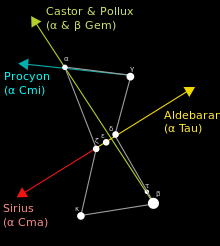
Cubs working on their astronomy badge should recall that Sirius is easy to find. It's the very bright star, trailing Orion slightly to the south and east. From Etobicoke we can see down to magnitude 4 on a good night.

And if you want to look at more, there's always the wonders in Orion!

Friday, February 8, 2008

Astronomers Badge

Stumble Upon Toolbar
Image courtesy of NASA, the Comet is a bonus, click on image for more info
(Credit: Alessandro Dimai at the
Col Druscie Observatory)
The 433rd has been working on the astronomer badge. The (paraphrased) requirements include:
  1. Showing how to use the pointer stars (Merak and Dubhe) of the Big Dipper to find the Polaris (the North Star - the comet in the photo shows the way).
  2. Using a star chart and finding 5 constellations, see Planispheres.
  3. Learning and relating star lore (classical or aboriginal), see the Wolf Moon for one example.
  4. Knowing and describing 3 (astronomical) features of the sky, such as comets, asteroids, planetary rings, strange quasi-moons, or other news.
  5. Knowing about the phases of the moon and tides, see the Tides Game.

Earning an astronomer badge automatically counts for Black Star requirement A11 (finding the north star and 3 constellations).

Requirement 1 is paramount as it can be used to find direction!

Some easy constellations to find (in the northern hemisphere) include:
I would be interested in hearing from Cubs outside of Canada about astronomy requirements in their badges and awards. In particular, I would love to hear from Scouters in the southern hemisphere.

Update: Above I noted that Cubs can double dip on requirements for the Black Star. It turns out they can actually triple dip as the Winter Cubbing badge has a requirement to find the North Star and three night sjy objects!

Update: If you are a Cub leader outside if Canada, please also read The Great Astronomers Badge Swap.  And please click on the BadgeSwap label below to see other related badges and entries.

Tuesday, January 29, 2008

Build your own Planisphere (Star Finder)!

Stumble Upon Toolbar
One of the Astronomer badge requirements is to use a seasonal star chart. One of the most compact and useful star charts is called a Planisphere, Star Finder, or Star Wheel.

Tonight we will send home star finders with our Cubs. Our planisphere came from the National Research Council of Canada web site as a downloadable template you can make yourself, here. For best results print the template on stiff card stock.

The NRC also an online star chart and information on constellations and other astronomy, here. In fact, you could get most of what you need to earn your Astronomers badge from this site alone.

Using a planisphere is simplicity itself, you just dial the disk until the time of day lines up with the current date. Hold it above your head as you look to the sky (otherwise east and west are reversed).

You should adjust for Daylight Savings Time, by subtracting one hour when it is in effect. You don't need to adjust for leap years as the day to day change in the position of the stars is much less than an hour of the Earth's rotation.

Planispheres are actually designed for observers at specific distances from the equator (latitudes). A planisphere disk for Canada and the US, doesn't work well above the Arctic circle or close to the equator. Entirely different planisphere frames and disks are required in the southern hemisphere as the directions reverse.

Some other star finders templates:
  • The State of New Jersey publishes one, here. It's not too much different than the NRC one.
  • The Royal Astronomical Society of Canada has one, here. And other resources, here.
  • A southern hemisphere template can be found, here.
  • A northern and southern hemisphere templates can be found, here.
  • A Lakota star chart that may be usable in a planisphere frame can be found, here, with more information, here.
High quality planispheres can be purchased from local astronomy stores or online. One innovative design reduces edge distortion using a two sided approach, here.

Sunday, January 27, 2008

The Toronto Fire Service visits the 433rd!

Stumble Upon Toolbar
At our last meeting, we had a visit from the Toronto Fire Service.


We learned about basic fire safety, including:
  • smoke alarms (batteries and hush buttons)
  • a family escape plan and meeting spots
  • calling 911 immediately
  • crawling out under the smoke
  • stop, drop, and roll
  • not reentering the building for any reason
  • not opening windows and blocking the crack under the door
  • making yourself obvious to firefighters (dancing in the window and not hiding in your room)
We also
  • learned about some of the leading causes of fires in Toronto.
  • saw a demonstration of firefighting clothing
  • had a fun obstacle course to test our fire skills

This activity counts towards our Family Safety Badge and Blue Star requirement B4.

Safety kits including an escape planning guide were sent home.

In the next couple of weeks Cubs can bring their completed plan in and we will complete the badge work.

Here are some links to fire safety resources:
  • Toronto fire prevention resources, here.
  • Sparky the Fire Dog, a kid and family focused site, here.
  • Kid focused activities for teachers from the Ontario Fire Marshall's Safety Council, here.
  • Parent resources from the the Ontario Fire Marshall's Safety Council, here.
  • Ontario Office of the Fire Marshall's main safety page, here.
Special thanks to Colin's mom and the TFS!

Tuesday, January 22, 2008

The Wolf Moon!

Stumble Upon Toolbar
Tuesday, January 22, 2008 at 8:35 a.m. EST is the full Wolf Moon! It may just be visible in the western sky when you wake and before school.

Native Americans named all the full moons and the months they occurred in. For a full list and more information see here and here. Some of these names, like Harvest and Hunter moons persist in popular use toady.
  • February 20th is the full Snow Moon and a total lunar eclipse (the safe to look at kind of eclipse). UPDATE: For more eclipse information, including times check this out.
  • November 13th, is the full Beaver Moon
Information on aboriginal star lore was largely word of mouth. Thankfully, people are now documenting it. There is a book on Inuit star lore and some websites dealing with Lakota star lore, including charts, here.

Knowledge of classical mythological or aboriginal star lore counts towards the Astronomers badge (requirement 3).

Tuesday, January 15, 2008

The Tides Game

Stumble Upon Toolbar
The Tides Game is an educational steam-off game. The game illustrates the affect of the moon on the Earth's Oceans.

The players:
  • "moon" - a cub
  • "sun" - a cub/leader
  • "ocean" - the pack
Have the pack assemble in a parade circle. Explain that the part of the ocean closest the moon moves towards the moon slightly (one step outward) and that the ocean on the opposite side of the world will move in the opposite direction. After the moon passes, the ocean returns to its normal position.

Have the moon circle the Earth a few times.

Once they get the hang of the Moon, add the Sun. The Sun moves around the outside much slower. When the Moon and Sun line up, have the cubs take an extra step.

The game starts out slowly and gets faster.

For added fun and silliness, start with moon & sun moving normally and later add extra moons.

This should help your cubs understand the basics of tidal movement. Of course our tides are a bit more complicated that this, but it conveys the basics.

Astronomy Badge: requirement 5 (Know phases of the moon and moons role in causing tides).

Wednesday, December 12, 2007

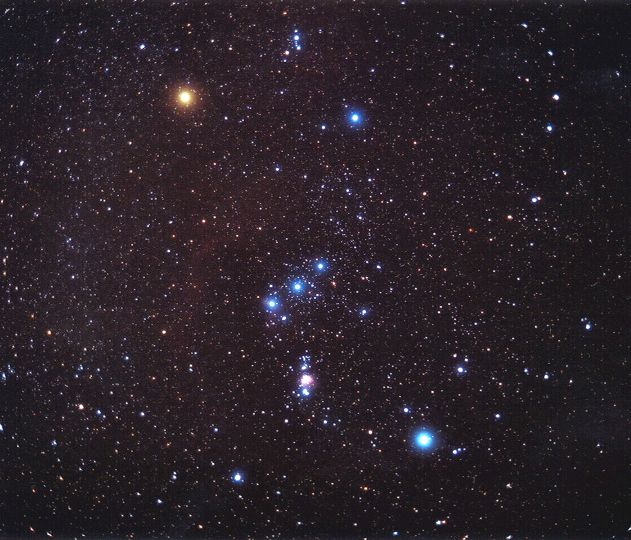
Orion returns to the evening sky

Stumble Upon Toolbar
Image courtesy of NASA APOD, click image for more info
(Credit & Copyright: Matthew Spinelli)

Fall stargazing can be tough with all the overcast evenings we get. Tonight was one of those cool clear nights where the stars were brilliant and I was out for a walk. The first thing I saw was Orion low in the south east. Even through city light pollution it is magnificent.

Cubs need to know five constellations as part of their astronomy badge. Orion is an excellent choice because it is easy to find, provides easy pointers to other constellations, and contains a number of interesting objects that are also part of the knowledge needed for the astronomy badge.

Orion's belt is a cluster of three stars running east to west that have been credited for the positioning of Giza's famous pyramids (this has been debunked see Wikipedia). Orion's left shoulder is Betelgeuse, a massive red giant that would swallow Earth and Mars if it replaced our Sun. It so big and the gases inside it so spread out that it has been called a red hot vacuum. It is also the first star, aside from our Sun, to have a picture taken showing anything more than a point of light! One day this star will explode in a supernova bright enough to be seen in daylight. Then it will fade away.

Just below Orion's belt is a series of stars and nebula that are often referred to as Orion's sword. Among these is the great Orion Nebula a stellar nursery where new stars are being born.

Tuesday, November 13, 2007

Knot Games

Stumble Upon Toolbar
I found some Games involving Knots here.