Monday, February 23, 2009
Astronomy Tips for the Observer
Labels:
Astronomy
Friday, February 20, 2009
Carnival of Space #91 @ Next Big Future
See this weeks Carnival for Europa, Saturn, Mars, a metor in Texas, Scouts Canada, an eclipse
of the Earth, a collision in space, the Super Orion really really big
heavy lift vehicle, and a cake that needs 445 candles!
Labels:
CarnivalOfSpace
Monday, February 16, 2009
Make Your Stargazing Events Shine
Jim Cornish’s article on the Night Sky is a great introduction to
stargazing. With a little practice, even people unfamiliar with the stars can
build their knowledge and confidence to lead a stargazing event.
Keep it Comfortable
Lying in a clearing, gazing up at the stars can be a wonderful experience. Use ground sheets or camp mattresses to keep away the damp. Mug up (a snack and drink) afterwards is always welcome.
Can’t see the Constellations for the Stars?
Switching from urban to dark sky observing can be almost overwhelming the first few times. Stars that you could easily find in the city can get lost in the vivid background of the Milky Way. If you’re looking for something specific, try getting out for a practice look or allow extra time. If you have a telescope, make sure the finder and main scope are properly aligned or you may find yourself lost in space.
Planning your Event
Before you go out, consider building planispheres (star wheels) and practicing with them at a meeting. Free templates for cardboard ones can be found on-line (or on my blog). You could also prepare some astronomical flashlights. Attach several layers of red cellophane over the ends of flashlights, holding them on with elastic bands. Try and see how little light you need to read.
Sites such as http://www.skyandtelescope.com/observing/ataglance provide information about what planets are visible in the night sky. For satellites and observing forecasts, you need location specific information. Two sites I recommend for this are:
Tailor your event to your age group. Organize parallel events to keep attention and events manageable (especially if equipment is involved).
If you are using equipment, such as a telescope that requires setup, get to your site before your group and leave enough time to set up and adapt your eyes to the dark. Remember to keep the lens and eyepieces covered until use to prevent dew buildup on them.
Have other leaders take your group on a pre-watch night hike. Keep flashlights off to get their eyes adapted for night vision (about 20 minutes).
Break into smaller groups and rotate through the activities. One group can look at constellations, the Milky Way, and perhaps meteors and satellites. Another can use their planispheres. A binocular group can look at nebula, open clusters, the Andromeda Galaxy, and perhaps a comet. Use the telescope to look at planets, binary stars, globular clusters, smaller nebula, and galaxies. Take care to have the youth move their eye to the eyepiece and not touch the scope. Telescopes will need to be adjusted every few minutes to compensate for the Earth’s rotation unless they are capable of tracking.
Clear skies everyone!
— David Gamey is an enthusiastic Scouter with the 433rd Toronto Scouting Group, who has developed his own ScoutBlog with articles on compassless navigation, building planispheres, choosing binoculars and telescopes, integrated SkyForecast charts for some Scout camps, ringed planets, Earth’s other moons, and much more. Check out the site using category labels such as http://mangsbatpage.433rd.com/search/label/Astronomy or http://mangsbatpage.433rd.com/search/label/SkyForecast.
This article by David Gamey previously appeared in Scouting Life Magazine and is reprinted with permission of Scouts Canada.
Super Astronomy Books
This is the year with all kinds of educational and awareness events happening on a global and local level. For more information and resources see http://www.astronomy2009.org/. Look for sites and events sporting their official logo.
There are 11 cornerstone projects — something for everyone!
Earth Hour – March 28, 2009
Earth Hour will allow us to appreciate dark skies and how we can help the environment. See http://www.earthhour.org/. Plan on joining in now, and watch for ideas on how to do so in the March/April issue of Scouting Life.
Related Articles
Keep it Comfortable
Lying in a clearing, gazing up at the stars can be a wonderful experience. Use ground sheets or camp mattresses to keep away the damp. Mug up (a snack and drink) afterwards is always welcome.
Can’t see the Constellations for the Stars?
Switching from urban to dark sky observing can be almost overwhelming the first few times. Stars that you could easily find in the city can get lost in the vivid background of the Milky Way. If you’re looking for something specific, try getting out for a practice look or allow extra time. If you have a telescope, make sure the finder and main scope are properly aligned or you may find yourself lost in space.
Planning your Event
Before you go out, consider building planispheres (star wheels) and practicing with them at a meeting. Free templates for cardboard ones can be found on-line (or on my blog). You could also prepare some astronomical flashlights. Attach several layers of red cellophane over the ends of flashlights, holding them on with elastic bands. Try and see how little light you need to read.
Sites such as http://www.skyandtelescope.com/observing/ataglance provide information about what planets are visible in the night sky. For satellites and observing forecasts, you need location specific information. Two sites I recommend for this are:
- Clear Sky Charts http://cleardarksky.com/csk/ provides the best observing forecasts for over 3,500 locations. These charts give much more information than cloud cover and precipitation.
- Heavens Above http://www.heavens-above.com/ provides information on satellites including the Space Station, Shuttle, Iridium flares, and others. You do need to configure your latitude, longitude and altitude to get accurate predictions.
Tailor your event to your age group. Organize parallel events to keep attention and events manageable (especially if equipment is involved).
If you are using equipment, such as a telescope that requires setup, get to your site before your group and leave enough time to set up and adapt your eyes to the dark. Remember to keep the lens and eyepieces covered until use to prevent dew buildup on them.
Have other leaders take your group on a pre-watch night hike. Keep flashlights off to get their eyes adapted for night vision (about 20 minutes).
Break into smaller groups and rotate through the activities. One group can look at constellations, the Milky Way, and perhaps meteors and satellites. Another can use their planispheres. A binocular group can look at nebula, open clusters, the Andromeda Galaxy, and perhaps a comet. Use the telescope to look at planets, binary stars, globular clusters, smaller nebula, and galaxies. Take care to have the youth move their eye to the eyepiece and not touch the scope. Telescopes will need to be adjusted every few minutes to compensate for the Earth’s rotation unless they are capable of tracking.
Clear skies everyone!
— David Gamey is an enthusiastic Scouter with the 433rd Toronto Scouting Group, who has developed his own ScoutBlog with articles on compassless navigation, building planispheres, choosing binoculars and telescopes, integrated SkyForecast charts for some Scout camps, ringed planets, Earth’s other moons, and much more. Check out the site using category labels such as http://mangsbatpage.433rd.com/search/label/Astronomy or http://mangsbatpage.433rd.com/search/label/SkyForecast.
This article by David Gamey previously appeared in Scouting Life Magazine and is reprinted with permission of Scouts Canada.
Super Astronomy Books
- Night Watch: A Practical Guide to Viewing the Universe by Terence Dickinson
- Celestial Sites, Celestial Splendors by Herve Burillier
- Turn Left at Orion: A Hundred Night Sky Objects to See in a Small Telescope – and How to Find Them by Guy Consolmagno, et al
- The Backyard Astronomer’s Guide by Dickinson& Dyer.
This is the year with all kinds of educational and awareness events happening on a global and local level. For more information and resources see http://www.astronomy2009.org/. Look for sites and events sporting their official logo.
There are 11 cornerstone projects — something for everyone!
Earth Hour – March 28, 2009
Earth Hour will allow us to appreciate dark skies and how we can help the environment. See http://www.earthhour.org/. Plan on joining in now, and watch for ideas on how to do so in the March/April issue of Scouting Life.
Related Articles
Labels:
Astronomy,
CarnivalOfSpace,
ScoutingLife
Explore the Night Sky
“Mortal as I am, I know that I am born for a day. But when I follow at my
pleasure the serried multitude of the stars in their circular course, my feet
no longer touch the earth.”
— Ptolemy, c.150 A.D.
A night sky studded with stars has fascinated humankind for millennia. Thinking they were deities, the ancient Babylonians, Egyptians and Chinese organized them into constellations; making star maps to predict cataclysmic events or planting and harvest times, and to mark religious celebrations. Amazingly, some of these same constellations remain as part of astrology and modern astronomy. So, when taking your youth stargazing, you are doing more than earning a badge; you are engaging in a wondrous experience, as old as humanity itself.
Sky Maps
There are 88 constellations spread across the northern and southern hemispheric sky. To locate the ones overhead in your area, think of the night sky as a huge dome with stars stuck on its inside surface. Just as you need a map when exploring an unfamiliar landscape, use a sky map as your guide. Star maps can be purchased at a local book/magazine store or downloaded from several astronomy-related web sites on-line. Some of the on-line versions can even be customized to your exact longitude and latitude!
Since sky maps are held over your head when looking skyward, they will show the east/west cardinal points switched around when laid on your lap. To use the map properly, hold it printed side up, then rotate it clockwise 180 degrees. Keeping the face of the map visible, lift it over your head. With N on the map pointing northward, east and west will now be properly aligned. The center of the map is the part of the sky nearly or directly overhead. The outer circle of the sky map corresponds to the horizon.
You may need a flashlight to read a printed sky map. Cover the lens with red cellophane or a red sock to produce a red light that makes reading the map possible without affecting your night vision. Better yet, use commercial “glow-in-the-dark” maps.
Like all areas of study, astronomy has its own language. Understanding and using its vocabulary is essential when searching for constellations. See “Words You Gotta Know” (www.skyandtelescope.com/howto/basics/Words_Ya_Gotta_Know.html) for a great list.
Let’s Get Started
Sources of Printable Sky Maps
Skymaps
www.skymaps.com/downloads.html
Starry Night Online
www.space.com/snserver/snweb.php
(Type in your postal code and receive an up-to-the-minute, on-line sky map for your exact location.)
Star Bright, Star Light
On a perfectly clear and pitch-black night, only 1,500 stars are visible overhead. Most stargazers focus on just the 26 brightest, working through them one constellation at a time.
Most stars are suns and no two are exactly alike. They either glow dull red, blue, yellow or white. Varying from a few to several million kilometres in diameter, they are basically huge balls of mostly hydrogen gas held together by their own mass and producing enough gravity to create a constant fusion reaction in their cores.
The study of a specific star begins by first finding the constellation in which it appears and then locating where in the constellation it is positioned. To find Betelgeuse (pronounced beetle juice) for example, find Orion first. Betelgeuse is in the upper left hand corner and marks Orion’s right shoulder. Being a red supergiant, it is the ninth brightest star in the night sky. While cooler than our sun, it is more massive and over 1000 times larger. If placed at the center of our Solar System, it would extend past the orbit of Jupiter.
Orion has more surprises. Another of its stars is a binary — two stars appearing as one as they revolve around one another. Another star is actually a star cluster. A star-like object located in Orion’s sword hanging straight down from the middle star of his three starred belt and visible with the naked eye is actually a nebulae — a huge gaseous cloud.
The Planets
Of course, not all of the points of light in the night sky are stars, nebulae or galaxies. Five of them (Mercury, Venus, Mars, Jupiter and Saturn), move among the “fixed” stars and were named “planets” (wanderers) by the ancient astronomers. The three remaining planets (Pluto recently lost its planetary status) are not visible with the naked eye. It was Galileo who discovered the planets were not rogue stars but worlds like our own. By noting the changing positions of stars and planets over the course of two or more nights, you can witness how the Earth’s yearly motion around the sun alters the position of objects in the night sky. With the aid of a binoculars or a telescope, features such as phases, moons, rings and surface storms may also be visible. This site provides a good guide to the Solar System: www.astronomytoday.com/astronomy/solarsystem.html.
Shooting Stars
“Shooting star” is the name used to describe a meteor — an intense streak of light across the night sky. Meteors form when small bits of interplanetary rock and debris called meteoroids burn as they pass through the Earth’s upper atmosphere. The rare few meteors that survive the plunge and hit the earth are known as meteorites. While it’s possible to see a” shooting star” any clear night, there are times of the year when they seem to” shower” the earth.
Meteor showers are named after the constellations from which they seem to appear. One of the most spectacular showers is the Perseid which produces between 40 to 60meteors per hour around August 12/13 each year. Other strong meteor showers are listed in a calendar at: www.meteorshowersonline.com/calendar.html.
Artificial Stars
Unlike meteors which streak quickly and for only a short distance, some points of light move gracefully west to east from horizon to horizon. These are satellites — man-made objects launched into space for relaying messages, observing the weather, mapping the earth’s surface and even spying on other countries. Satellites can be best seen during the two hours right after sunset and two hours before sunrise when they best reflect the light of the setting/rising sun. You can tell where the satellites are orbiting by their speeds and brightness. Satellites orbiting on lower levels usually move faster and brighter than those located higher above the earth. One of these moving lights could be the International Space Station (ISS). To learn of possible IS sighting times for your area of Canada, visit: www.spaceflight1.nasa.gov/realdata/sightings/cities/skywatch.cgi?country=Canada.
Just Look Up
From believing that the stars and planets are gods and goddesses and that Earth is the center of the universe to now knowing that our sun is just one of hundreds of billions of stars that make up just our own galaxy in a vast universe of galaxies, human knowledge has taken an amazing journey over the past 5000 years. And like the great earthly and heavenly explorers of the Renaissance who separated fact from fiction, astronomers today continue to venture into unimaginable places. Just where this journey will take us, no one knows, yet we can share part of it by just looking up.
— Jim Cornish is a 5th grade science teacher inGander , NL, an amateur
photographer, and loves sharing the joys of learning with his students.
Cubs – Astronomer Badge, #1 - 4
Star Myths
Reading aloud the myths of the constellations passes the time while waiting for eyes to adjust to the darkness. Tailor the story to the age of the youth and the constellation you are going to find. For instance, read aloud the story of Orion, and then find Orion in the sky.
Indoor Stargazing Activities
Make Your Own Constellations
Make Constellations in a Canister @ About.com
and www.wnit.org/outdoorelements/pdf/Constellation_Canisters.pdf
Mythology of the Constellations @ ComfyChair.org
Make a Star Finder @ NASA's Spaceplace for Kids
Orion the Hunter
See http://stardate.org/nightsky/constellations/orion.html
Give Me More
More interesting star web sites can be found on Scouts Canada’s web site, under Scouting Life’s current (January 2009) issue, as an additional page.
This article by Jim Cornish previously appeared in Scouting Life Magazine and is reprinted with permission of Scouts Canada and the author.
Related Articles
— Ptolemy, c.150 A.D.
A night sky studded with stars has fascinated humankind for millennia. Thinking they were deities, the ancient Babylonians, Egyptians and Chinese organized them into constellations; making star maps to predict cataclysmic events or planting and harvest times, and to mark religious celebrations. Amazingly, some of these same constellations remain as part of astrology and modern astronomy. So, when taking your youth stargazing, you are doing more than earning a badge; you are engaging in a wondrous experience, as old as humanity itself.
Sky Maps
There are 88 constellations spread across the northern and southern hemispheric sky. To locate the ones overhead in your area, think of the night sky as a huge dome with stars stuck on its inside surface. Just as you need a map when exploring an unfamiliar landscape, use a sky map as your guide. Star maps can be purchased at a local book/magazine store or downloaded from several astronomy-related web sites on-line. Some of the on-line versions can even be customized to your exact longitude and latitude!
Since sky maps are held over your head when looking skyward, they will show the east/west cardinal points switched around when laid on your lap. To use the map properly, hold it printed side up, then rotate it clockwise 180 degrees. Keeping the face of the map visible, lift it over your head. With N on the map pointing northward, east and west will now be properly aligned. The center of the map is the part of the sky nearly or directly overhead. The outer circle of the sky map corresponds to the horizon.
You may need a flashlight to read a printed sky map. Cover the lens with red cellophane or a red sock to produce a red light that makes reading the map possible without affecting your night vision. Better yet, use commercial “glow-in-the-dark” maps.
Like all areas of study, astronomy has its own language. Understanding and using its vocabulary is essential when searching for constellations. See “Words You Gotta Know” (www.skyandtelescope.com/howto/basics/Words_Ya_Gotta_Know.html) for a great list.
Let’s Get Started
- Start your stargazing adventure indoors first. Become familiar with a good star guide book and sky map for the current season as well as your location on earth. Pick one or two constellations to look for and learn how to find them.
- When ready, find a high spot of ground away from any light source and where the horizon is visible.
- Allow a half hour for your eyes to adjust to the darkness. (See Star Myths sidebar for one way to pass the time.)
- Lie on your back with your feet pointed towards one of the cardinal points of the compass. Most stargazers begin by pointing north to find Polaris.
- Orient the sky map.
- Find Ursa Major (the Big Dipper), as a starting point.
- From there, focus your attention on finding the popular constellations (Ursa Minor - containing the Little Dipper), Orion (completely visible in winter), Cassiopeia, Leo and
VegaVirgo. Some star maps show star alignments you can use to find other stars and constellations. For example, after you locate the Big Dipper, look at the two stars that mark the outer edge of its bowl. Connect these two stars with an imaginary line and extend itbelowbeyond the dipper’s bowl. Polaris, the North Star, lies along this line, about five times the distance between the two pointers. No matter where the Big Dipper is in our sky, these two pointer stars always point to Polaris. - Be patient. There is a lot in the night sky to study. Wait for a clear night.
Sources of Printable Sky Maps
Skymaps
www.skymaps.com/downloads.html
Starry Night Online
www.space.com/snserver/snweb.php
(Type in your postal code and receive an up-to-the-minute, on-line sky map for your exact location.)
Star Bright, Star Light
On a perfectly clear and pitch-black night, only 1,500 stars are visible overhead. Most stargazers focus on just the 26 brightest, working through them one constellation at a time.
Most stars are suns and no two are exactly alike. They either glow dull red, blue, yellow or white. Varying from a few to several million kilometres in diameter, they are basically huge balls of mostly hydrogen gas held together by their own mass and producing enough gravity to create a constant fusion reaction in their cores.
The study of a specific star begins by first finding the constellation in which it appears and then locating where in the constellation it is positioned. To find Betelgeuse (pronounced beetle juice) for example, find Orion first. Betelgeuse is in the upper left hand corner and marks Orion’s right shoulder. Being a red supergiant, it is the ninth brightest star in the night sky. While cooler than our sun, it is more massive and over 1000 times larger. If placed at the center of our Solar System, it would extend past the orbit of Jupiter.
Orion has more surprises. Another of its stars is a binary — two stars appearing as one as they revolve around one another. Another star is actually a star cluster. A star-like object located in Orion’s sword hanging straight down from the middle star of his three starred belt and visible with the naked eye is actually a nebulae — a huge gaseous cloud.
The Planets
Of course, not all of the points of light in the night sky are stars, nebulae or galaxies. Five of them (Mercury, Venus, Mars, Jupiter and Saturn), move among the “fixed” stars and were named “planets” (wanderers) by the ancient astronomers. The three remaining planets (Pluto recently lost its planetary status) are not visible with the naked eye. It was Galileo who discovered the planets were not rogue stars but worlds like our own. By noting the changing positions of stars and planets over the course of two or more nights, you can witness how the Earth’s yearly motion around the sun alters the position of objects in the night sky. With the aid of a binoculars or a telescope, features such as phases, moons, rings and surface storms may also be visible. This site provides a good guide to the Solar System: www.astronomytoday.com/astronomy/solarsystem.html.
Shooting Stars
“Shooting star” is the name used to describe a meteor — an intense streak of light across the night sky. Meteors form when small bits of interplanetary rock and debris called meteoroids burn as they pass through the Earth’s upper atmosphere. The rare few meteors that survive the plunge and hit the earth are known as meteorites. While it’s possible to see a” shooting star” any clear night, there are times of the year when they seem to” shower” the earth.
Meteor showers are named after the constellations from which they seem to appear. One of the most spectacular showers is the Perseid which produces between 40 to 60meteors per hour around August 12/13 each year. Other strong meteor showers are listed in a calendar at: www.meteorshowersonline.com/calendar.html.
Artificial Stars
Unlike meteors which streak quickly and for only a short distance, some points of light move gracefully west to east from horizon to horizon. These are satellites — man-made objects launched into space for relaying messages, observing the weather, mapping the earth’s surface and even spying on other countries. Satellites can be best seen during the two hours right after sunset and two hours before sunrise when they best reflect the light of the setting/rising sun. You can tell where the satellites are orbiting by their speeds and brightness. Satellites orbiting on lower levels usually move faster and brighter than those located higher above the earth. One of these moving lights could be the International Space Station (ISS). To learn of possible IS sighting times for your area of Canada, visit: www.spaceflight1.nasa.gov/realdata/sightings/cities/skywatch.cgi?country=Canada.
Just Look Up
From believing that the stars and planets are gods and goddesses and that Earth is the center of the universe to now knowing that our sun is just one of hundreds of billions of stars that make up just our own galaxy in a vast universe of galaxies, human knowledge has taken an amazing journey over the past 5000 years. And like the great earthly and heavenly explorers of the Renaissance who separated fact from fiction, astronomers today continue to venture into unimaginable places. Just where this journey will take us, no one knows, yet we can share part of it by just looking up.
— Jim Cornish is a 5th grade science teacher in
Cubs – Astronomer Badge, #1 - 4
Star Myths
Reading aloud the myths of the constellations passes the time while waiting for eyes to adjust to the darkness. Tailor the story to the age of the youth and the constellation you are going to find. For instance, read aloud the story of Orion, and then find Orion in the sky.
Indoor Stargazing Activities
Make Your Own Constellations
Make Constellations in a Canister @ About.com
and www.wnit.org/outdoorelements/pdf/Constellation_Canisters.pdf
Mythology of the Constellations @ ComfyChair.org
Make a Star Finder @ NASA's Spaceplace for Kids
Orion the Hunter
See http://stardate.org/nightsky/constellations/orion.html
Give Me More
More interesting star web sites can be found on Scouts Canada’s web site, under Scouting Life’s current (January 2009) issue, as an additional page.
This article by Jim Cornish previously appeared in Scouting Life Magazine and is reprinted with permission of Scouts Canada and the author.
Related Articles
Labels:
Astronomy,
CarnivalOfSpace,
ScoutingLife
Sunday, February 15, 2009
Thursday, February 12, 2009
Easy "Red Eye" Exit Pupil Method
The rule of thumb used is that the exit pupil should be 7 mm. In binoculars, a 7x50 (7 power x 50 mm lens) is considered a near perfect fit for star gazing because it matches the exit pupil. A 10x70 would also be an excellent fit, but an 8x25 wouldn't provide enough light.
For more on this see Visual Astronomy on The Effects of Exit Pupil.
My son recently completed a Science Fair project on night vision which looked at pupil size and age. To get enough data he needed a quick, easy, and reliable method of measuring pupil size in the dark. They couldn't take everyone to an eye doctor and the "slit" method was neither easy nor quick.
What he came up with was the "red eye" method. By taking a flash photo with a digital camera after about a minute of darkness you can then use software like Photoshop or GIMP to measure the diameter of the red eye in pixels. The only other thing you need is an object of known size to find the number of pixels per mm. For this he used a dime (18 mm) on a Popsicle stick.
The photo above shows a 7 year old with an amazing 9mm pupil!
Later, I'll provide more about pupil size and age.
Related Articles
Thursday, February 5, 2009
Astronomy Links from Jan/Feb 2009 Scouting Life Magazine
The January/February 2009 issue of Scouting Life Magazine featured an astronomy article "Explore the Night Sky" by Jim Cornish and a companion article "Make Your Stargazing Events Shine" by myself. These contained a number of web page links which you can find below:
Explore the Night Sky
Make Your Stargazing Events Shine
More Astronomy Links (Scouting Life Website)
Explore the Night Sky
- Words Ya Gotta Know from Sky and Telescope
- Printable Sky Maps from Skymaps.com
- Printable Sky Maps from Starry Night Online
- The Planets and Solar System from Astronomy Today
- A Shooting Star Calendar from Meteorshowers Online
- Artificial Stars from NASA Orbital Tracking
- Make your own Constellations (in a Canister) from About.com Space
- The Mythology of the Constellations from Comfy Chair
- Make a Star Finder from NASA's Space Place for Kids
Make Your Stargazing Events Shine
- This Week's Sky at a Glance from Sky and Telescope
- Observing Forecasts for over 3,500 locations from Clear Sky Charts
- Charts on Satellite, Space Station, Shuttle flights and others from Heaven's Above
More Astronomy Links (Scouting Life Website)
- Night Sky from Space.com
- Night Sky Video from the Hubble Site
- The 10 Brightest Stars from SPACE.com
- The 26 Brightest Stars from WISC
- Welcome to the Planets from NASA's JPL (corrected)
- Shoebox Planetarium from Middleschool Science
- Tin Can Planetarium from Familyfun (note: article is at the very bottom of the page)
- Cyberchase Games Star Gazing from PBS Kids
- Star Journey from National Geographic
- The Hubble Space Telescope Site from NASA
- Stargazing Basics from Sky and Telescope
- Windows to the Universe from UCAR
- Sky Almanac from StarDate Online
- Stargazing Weather for Canadian Cities from The Weather Network
- 2009 Monthly Sky Guides from About.com Space (updated)
- Constellations by Month from WISC
- Your Sky from Formilab
- Sky Map from Sky Map
- Sky Cafe Interactive Planetarium from Sky View Cafe
- Google Sky
Labels:
Astronomy
Friday, January 30, 2009
Carnival of Space #88 @ TheSpaceWriters' Ramblings!
Another week and another Carnival. This week we're invited to Come into the Big Top
over at The Spacewriter's Ramblings.
Find out the truth about astrology, a disease aflicting astronomers, and more cool stuff.
over at The Spacewriter's Ramblings.
Find out the truth about astrology, a disease aflicting astronomers, and more cool stuff.
Labels:
CarnivalOfSpace
Wednesday, January 28, 2009
How You Could Pilot a Space Telescope (Upside Down)
This is the second in a series of articles on my experiences working with the MOST team on a study of Betelgeuse. This time, I look at the process of selecting targets and pointing the telescope.
When I first heard about public proposals for MOST (Microvariability and Oscillations of STars), I was quite interested and spent some time reading up on MOST on both the main web site and the outreach web site called MOST = My Own Space Telescope. I needed to understand both the capabilities of MOST and its limitations.
I should note that the proposal site is still open and accepting proposals. Just perhaps, you too may get a chance to pilot a space telescope.
What can MOST do?
MOST was designed to detect minute variations in light intensity in stars which turns out to be very useful if you are looking at things like:
It turns out there are lots of things on which MOSTs strengths can be brought to bear:
The MOST Science Team chooses targets based on the science they want to explore. What types of variations can teach them about the nature and life story of a star or planets around it? Are those variations likely in a particular star? And is MOST sensitive enough to see those particular variations in that particular star?
I think of this as the “bottom up” approach. I decided that as an amateur not immersed in the details and subtleties of astrophysics my best bet would be to play a different game and try a top down approach.
This approach led me to make a list of visually interesting and recognizable stars most of which were observable with the naked eye. My reason for choosing recognizable stars was to better connect with the public. Next I investigated the list for stars that would be (a) accessible to MOST and (b) suitable science targets for its mission. Again the order may seem upside down but determining visibility was easier to do in bulk than doing the research first.
My initial list contained over 50 stars and resulted in five proposals covering six stars. Below are a few of the ones not accessible to MOST for long durations:
How do I aim this thing?
The MOST = My Own Space Telescope public proposals page contains a lot of background on choosing target stars for MOST and the process for the public to submit proposals. Once you've selected an interesting target, you need to ensure that MOST can see it.
Targets (with some exceptions) need to be meet two major positional constraints (1) the CVZ or Continuous Viewing Zone, and (2) the SSR or Sun Sensor Range. The CVZ dictates how long MOST can look at a star without interruption and the SSR constraint has to do with MOST keeping its back and its main solar panels to the Sun (as shown below on the left), as well as maintaining a reasonable temperature for the spacecraft. The proposal site has a Java based Target Validation Tool that checks all of this but I built one in a spread sheet to work with my long list.
The second chart (above and to the right) shows a plot of some of the target stars that have been selected and proposed as candidates. The red arrows point to Betelgeuse and LG 5039 (a microquasar) - the first two winning proposals submitted by myself and by Gordon Sarty.
Proposal Review by MOST Team
The proposals were examined by the MOST Science Team to ensure that the candidates were likely to yield good science data; and by the Operations Team to ensure that the target could be safely observed by the satellite. Successful proposals are announced and scheduled.
I should say a few words about the proposals themselves. The information needed by the team is not large. They need to know the target star, its name (or identifier) and coordinates, your contact information, and a brief description of why you think this would be a good subject of study. If you feel the need to write a bit more, there is a place to attach a small document. You can find the submission form here.
Fine Tuning the Aim
MOST follows a Science Target by tracking Guide Stars near the target in the telescopes field of view. All of the Target and Guide Stars must to be within a maximum of 0.86 degrees (a bit less than the twice the diameter of the full Moon). There must be enough Guide Stars of suitable brightness close to a target for that star to be observed. That is not normally a problem.
The spacecraft can be “rolled” around the position of the target to optimise the guide star selection and to include stars which are also of scientific interest. MOST can monitor up to about 40 stars at a time, greatly increasing the scientific returns. The roll angle of the satellite is also chosen to minimise scattered light from the Earth (“Earthshine”) falling onto the focal plane of the instrument. The Team then maps out the positions of the Primary Science Target, Direct Imaging Targets and Guide Stars. The image below shows the MOST target map for Betelgeuse:
As you can see, Betelgeuse (shown by the cross-hairs) is positioned under one of the central Fabry microlenses. The boxes show Guide Stars used to keep MOST pointing at Betelgeuse.
While in theory only two guide stars are required to keep the satellite pointed, in practice up to about 5 or 6 are actually used. All of these images are defocused over several pixels so that even minute variations in the intensity of the pixels watching a guide star can be used to detect and correct for any drift.
Another targeting wrinkle is that stars move ever so slightly due to what is know as "proper motion". Closer stars move more than ones further away. For example, Procyon (which has been studied by MOST) is very close to us compared to Betelgeuse and has a very much higher proper motion. The solution, a maneuver known as cross-hairs, takes sample measurements around the coordinates with the results being reviewed to fine tune the aim.
Keeping MOST on Target
MOST is able to keep itself pointed to a high degree of accuracy by combining information from several sensors that are listed below:
The other trick behind the ability of MOST to stare down a star for almost two months continuously is the orbit of the satellite. MOST orbits the Earth once about every 100 minutes but in a highly inclined orbit that keeps it moving east to west near the terminator so it can keep its back to the Sun and its front looking into the dark of deep space. Here is a track from Heavens Above of the orbit from near my location.
Switch Targets!
Not all targets require continuous observation and MOST has the ability to switch from one target to another in mid orbit. The process itself takes only a couple of minutes and it also means that some stars that are within the Sun Sensor limits but outside of the CVZ can be observed.
In fact one of my proposals was for pairs of targets which could be switched.
Here there beDragons Protons!
One of the hazards MOST faces is radiation. A stray zap from a high-energy particle can scramble its software or damage its components. And MOST travels through a particularly hazardous realm known as the South Atlantic Anomaly (a low arm of the inner Van Allen radiation belt).
The SAA is a potential satellite killer and MOST normally sails through it without harm. About once every two months, a cosmic ray hit during SAA passage can cause an on-board crash, from which MOST recovers usually by its next orbit. However, in January 2006, a very energetic particle hit disabled the original Star-tracker CCD, leaving only the Science CCD operational. The MOST Team always had a contingency plan to run the mission with only one CCD and it turns out that the performance of MOST is better than ever, after the MOST Team adapted to operating with a single CCD.
Adaptation!
MOST has changed since its launch. The teams have adapted and improved its capabilities in some surprising ways.
The MOST spacecraft buffers the science results and operational data until it can down link through one of three ground stations. Different send and receive frequencies are used. One interesting fact is that because the satellite is moving these radio frequencies must be Doppler shifted. Think of the horn of an approaching train and now try and imagine carrying on a conversation between two people on the ground and on the train.
A network of computers and computer programs are designed to divide and coordinate the work while providing fail over capabilities. The work is divided logically into managing communications at each ground station, managing the pass or snapshot data from the satellite, updating command and control, and managing the parsing, pre-formatting and distributing the down-linked data.
Related Articles and Other References:
I'd like to thank Dr. Jaymie Matthews, the Science Team, Ron Wessels, the Operations Team at MSCI (Microsat Systems Canada Inc. formerly the Space Systems division of Dynacon Inc.) for their cooperation and feedback. I'd also like to thank the MOST team, the University of British Columbia, and the Canadian Space Agency for permission to use their images.
Next Article: TBD
When I first heard about public proposals for MOST (Microvariability and Oscillations of STars), I was quite interested and spent some time reading up on MOST on both the main web site and the outreach web site called MOST = My Own Space Telescope. I needed to understand both the capabilities of MOST and its limitations.
I should note that the proposal site is still open and accepting proposals. Just perhaps, you too may get a chance to pilot a space telescope.
What can MOST do?
MOST was designed to detect minute variations in light intensity in stars which turns out to be very useful if you are looking at things like:
- Star quakes (vibrations in stars), pulsations and other variable behaviour caused by the star itself or by outside influences
- Dimming from stars, planets and even asteroid swarms passing in front of a star
- Increases in reflected light from large close-in planets orbiting a star
It turns out there are lots of things on which MOSTs strengths can be brought to bear:
- Looking for exoplanets (and swarms of exoasteroids)
- Turbulence and variability in massive stars like giants and Wolf-Rayet Stars (just one type of pre-supernova star).
- Variability in stars with companions such as black holes, pulsars, and dim dwarfs
- Seismic variations in smaller stars similar to our Sun and other classes of stars
The MOST Science Team chooses targets based on the science they want to explore. What types of variations can teach them about the nature and life story of a star or planets around it? Are those variations likely in a particular star? And is MOST sensitive enough to see those particular variations in that particular star?
I think of this as the “bottom up” approach. I decided that as an amateur not immersed in the details and subtleties of astrophysics my best bet would be to play a different game and try a top down approach.
This approach led me to make a list of visually interesting and recognizable stars most of which were observable with the naked eye. My reason for choosing recognizable stars was to better connect with the public. Next I investigated the list for stars that would be (a) accessible to MOST and (b) suitable science targets for its mission. Again the order may seem upside down but determining visibility was easier to do in bulk than doing the research first.
My initial list contained over 50 stars and resulted in five proposals covering six stars. Below are a few of the ones not accessible to MOST for long durations:
- La Superba - a very red carbon burning star in Canes Venatici
- Eta Carina - a hyper giant that experienced a nova like event in 1843 and a possible Wolf-Rayet precursor
- UW Canis Major - a Beta Lyra class contact binary - two giant stars orbiting each other every 5 day
- Albireo - a spectacularly coloured double in Cygnus
How do I aim this thing?
The MOST = My Own Space Telescope public proposals page contains a lot of background on choosing target stars for MOST and the process for the public to submit proposals. Once you've selected an interesting target, you need to ensure that MOST can see it.
Targets (with some exceptions) need to be meet two major positional constraints (1) the CVZ or Continuous Viewing Zone, and (2) the SSR or Sun Sensor Range. The CVZ dictates how long MOST can look at a star without interruption and the SSR constraint has to do with MOST keeping its back and its main solar panels to the Sun (as shown below on the left), as well as maintaining a reasonable temperature for the spacecraft. The proposal site has a Java based Target Validation Tool that checks all of this but I built one in a spread sheet to work with my long list.
Left mage credit: MOST Team, CSA and UBC
Right image plotted from my proposal spreadsheet.
The second chart (above and to the right) shows a plot of some of the target stars that have been selected and proposed as candidates. The red arrows point to Betelgeuse and LG 5039 (a microquasar) - the first two winning proposals submitted by myself and by Gordon Sarty.
Proposal Review by MOST Team
The proposals were examined by the MOST Science Team to ensure that the candidates were likely to yield good science data; and by the Operations Team to ensure that the target could be safely observed by the satellite. Successful proposals are announced and scheduled.
I should say a few words about the proposals themselves. The information needed by the team is not large. They need to know the target star, its name (or identifier) and coordinates, your contact information, and a brief description of why you think this would be a good subject of study. If you feel the need to write a bit more, there is a place to attach a small document. You can find the submission form here.
Fine Tuning the Aim
MOST follows a Science Target by tracking Guide Stars near the target in the telescopes field of view. All of the Target and Guide Stars must to be within a maximum of 0.86 degrees (a bit less than the twice the diameter of the full Moon). There must be enough Guide Stars of suitable brightness close to a target for that star to be observed. That is not normally a problem.
The spacecraft can be “rolled” around the position of the target to optimise the guide star selection and to include stars which are also of scientific interest. MOST can monitor up to about 40 stars at a time, greatly increasing the scientific returns. The roll angle of the satellite is also chosen to minimise scattered light from the Earth (“Earthshine”) falling onto the focal plane of the instrument. The Team then maps out the positions of the Primary Science Target, Direct Imaging Targets and Guide Stars. The image below shows the MOST target map for Betelgeuse:
MOST targeting image, December 15, 2008, credit: MOST Team, CSA and UBC
As you can see, Betelgeuse (shown by the cross-hairs) is positioned under one of the central Fabry microlenses. The boxes show Guide Stars used to keep MOST pointing at Betelgeuse.
While in theory only two guide stars are required to keep the satellite pointed, in practice up to about 5 or 6 are actually used. All of these images are defocused over several pixels so that even minute variations in the intensity of the pixels watching a guide star can be used to detect and correct for any drift.
Another targeting wrinkle is that stars move ever so slightly due to what is know as "proper motion". Closer stars move more than ones further away. For example, Procyon (which has been studied by MOST) is very close to us compared to Betelgeuse and has a very much higher proper motion. The solution, a maneuver known as cross-hairs, takes sample measurements around the coordinates with the results being reviewed to fine tune the aim.
Keeping MOST on Target
MOST is able to keep itself pointed to a high degree of accuracy by combining information from several sensors that are listed below:
- Position rate sensors which across 3 axis.
- The Sun Sensor which uses a small pinhole camera on the back of MOST to determine the position of our Sun.
- The two external Magnetometers (the large rods near the telescope opening) which sense variations in the Earth's magnetic field.
- The Star Tracker that uses Guide Stars imaged by the satellite.
The other trick behind the ability of MOST to stare down a star for almost two months continuously is the orbit of the satellite. MOST orbits the Earth once about every 100 minutes but in a highly inclined orbit that keeps it moving east to west near the terminator so it can keep its back to the Sun and its front looking into the dark of deep space. Here is a track from Heavens Above of the orbit from near my location.
Switch Targets!
Not all targets require continuous observation and MOST has the ability to switch from one target to another in mid orbit. The process itself takes only a couple of minutes and it also means that some stars that are within the Sun Sensor limits but outside of the CVZ can be observed.
In fact one of my proposals was for pairs of targets which could be switched.
Here there be
One of the hazards MOST faces is radiation. A stray zap from a high-energy particle can scramble its software or damage its components. And MOST travels through a particularly hazardous realm known as the South Atlantic Anomaly (a low arm of the inner Van Allen radiation belt).
NASA ROSAT image showing the SAA.
The SAA is a potential satellite killer and MOST normally sails through it without harm. About once every two months, a cosmic ray hit during SAA passage can cause an on-board crash, from which MOST recovers usually by its next orbit. However, in January 2006, a very energetic particle hit disabled the original Star-tracker CCD, leaving only the Science CCD operational. The MOST Team always had a contingency plan to run the mission with only one CCD and it turns out that the performance of MOST is better than ever, after the MOST Team adapted to operating with a single CCD.
Adaptation!
MOST has changed since its launch. The teams have adapted and improved its capabilities in some surprising ways.
- The loss of the guiding CCD forced the team to use the Science CCD for both pointing and science, and to come up with ways that actually enhanced the performance of the mission. A fringe benefit is that the reduced power consumption of one CCD extends the potential lifetime of the MOST mission.
- The Science Team wanted to extract scientific data from the Guide Stars and the Operations Team made that possible. In fact, MOST has observed approximately 1500 stars in the 5+ years it’s been in orbit. The limiting factor is the amount of memory to buffer results between down-links to Earth and the high sampling rates usually demanded by MOST science.
The MOST spacecraft buffers the science results and operational data until it can down link through one of three ground stations. Different send and receive frequencies are used. One interesting fact is that because the satellite is moving these radio frequencies must be Doppler shifted. Think of the horn of an approaching train and now try and imagine carrying on a conversation between two people on the ground and on the train.
A network of computers and computer programs are designed to divide and coordinate the work while providing fail over capabilities. The work is divided logically into managing communications at each ground station, managing the pass or snapshot data from the satellite, updating command and control, and managing the parsing, pre-formatting and distributing the down-linked data.
Related Articles and Other References:
- Betelgeuse, Betelgeuse, Betelgeuse! (The 1st article in this series, some interesting images of Betelgeuse, an introduction to
MOST's unusual imaging method, and an update on some facts about this
remarkable star.)
- MOST Science page
- Hot Jupiter Trojans! MOST finds exoasteroids?
- MOST caught on camera!
- Planets and Stars - video - Just how big are they?
- Mang gets a space telescope!
- Mang interviewed in Etobicoke Guardian
- Astronomical distances are .... (well) astronomical
- Orion returns to the evening sky
- Breaking news on NEOSSat
- Wikipedia list of brightest stars
- Wikipedia on Betelgeuse
- Making MOST (A scale model made by a Cub Pack)
- Tipsy Orion (when marketing misses the mark)
I'd like to thank Dr. Jaymie Matthews, the Science Team, Ron Wessels, the Operations Team at MSCI (Microsat Systems Canada Inc. formerly the Space Systems division of Dynacon Inc.) for their cooperation and feedback. I'd also like to thank the MOST team, the University of British Columbia, and the Canadian Space Agency for permission to use their images.
Next Article: TBD
Labels:
Astronomy,
SpaceExploration
Friday, January 23, 2009
Carnival of Space #87 - returns to Mars
The Carnival is back returning to the Martian Chronicles. Enjoy.
Labels:
CarnivalOfSpace
Monday, January 12, 2009
Carnival of Space #86 @ Collect Space
Another edition of the Carnival can be found here.
Labels:
CarnivalOfSpace
Thursday, January 8, 2009
Betelgeuse, Betelgeuse, Betelgeuse!
This is the first in a series of articles about my experience with the MOST (Microvariability and Oscillations of STars) team studying Betelgeuse in which Below are some interesting images of Betelgeuse, an introduction to MOST's unusual imaging method, and an update on some facts about this remarkable star.
Betelgeuse (α Orionis) is the 9th brightest star in our night sky visible in both the northern and southern hemispheres. Despite its alpha (α) designation, Betelgeuse is the 2nd brightest star in Orion after Rigel (it's variable and almost ties Rigel at its brightest). It's a red super giant much younger, heavier, and larger than our own Sun. It pumps out an enormous amount of energy and is expected to end its life in a spectacular supernova. Living fast and dying young.
Betelgeuse Photo Gallery
Our first image of Betelgeuse is a stunning photo of Orion and Mars and Monument Valley taken by Wally Pacholka (a former Scout and Scouter). Betelgeuse is the red star dead center. The familiar belt is vertical and the glow of the Orion nebula is clearly visible in the sword. Mars dominates the upper left.
Reprinted with permission see AstroPics.com for more of his work.
Next is the Hubble Space Telescope image from APOD taken in 1995 and the first image of the face of a star other than our Sun. The image is a false colour image combining several images taken with two different filters. The extreme difficulty of imaging the face of a star as more than a point can be seen in the pixel structure visible in the image. A large hot spot is visible on the disk.
Our next image is
Betelgeuse images, Credit: MOST Team, CSA and UBC.
Whoa! What's this? It's not actually a direct image but a false colour 3D representation. MOST sees only intensity. The terrain and color effects are just ways to emphasise the strength of the signal. The flat image to the right of the 3D version is closer to what MOST actually sees. These images are "stacks" of 30 individual exposures combined to form a single image. But what's actually behind the image?
Focus, Focus, Focus
Stars aren't donuts so why do these images look like one? Anyone who has ever focused any kind of reflecting telescope may be able to guess. The shape is a result of the telescope's construction (shown below). The telescope, a Rumak-Maksutov design, uses a compound optical path to get both a longer focal length and higher magnification. The primary mirror is donut shaped so the light can be reflected back through the hole to the imaging systems. This by itself won't cause the donut image. In perfect focus, a star will still image as point. But MOST isn't perfectly focused and that's why we see the donut.
Credit: MOST Team, CSA and UBC.
Wait, didn't the US Hubble Space Telescope have a focusing problem requiring a Shuttle mission to service the scope and install "glasses" to correct the problem? Surely we Canadians weren't doing a "me too"?! Why would anyone want to their images to be out of focus?
Firstly, MOST isn't as much a telescope as a photometer so it was never intended to take pretty pictures. Secondly, defocusing a star spreads its light out from a point inside one pixel over several (about 25) pixels. This has two important advantages:
- The intensity of light reaching individual pixels is reduced and they are less likely to be blinded by bright stars which would otherwise require much higher "shutter" speeds than the CCD is capable of.
- By using measurements from all of the pixels exposed for each guide star, MOST can effectively calculate the position of those stars to within a fraction of a pixel! Without this MOST could not maintain its rock steady aim.
Weirder still is the array of small Fabry microlenses that spread the light even further. To get the best data, MOST must keep the target star dead center in one of its Fabry lenses. The microlens produces an image of the mirror of the telescope, spread out over an area of about 1500 pixels (Ï€ * (25)^2 minus the area of the hole in the mirror).
The mirror is illuminated by the light of Betelgeuse so that starlight is spread evenly over the same area on the CCD. In another part of the focal plane, not under a Fabry microlens, each pixel would represent 3 arcseconds across the sky. But under the Fabry array, the sky is no longer being imaged. The telescope entrance pupil (the corrector in a Maksutov design) is projected in focus, and it is through that pupil that the star light is passing.
So in a sense, MOST is taking pictures of itself, lit up by Betelgeuse.
Not only does the defocusing prevent MOST from being blinded by the brightest stars, it gives MOST enormous sensitivity to detect very subtle variations in the stars it's tasked with watching. I attended a talk by Dr. Jaymie Matthews the Principal Scientist for MOST at the Mississauga RASC's December meeting. He has some wonderful analogies one of which puts the 1 ppm (part per million) sensitivity of this instrument into perspective. Imagine an image of the Empire State Building at night. MOST can detect a change in intensity of the light equivalent to raising or lowering one blind by 3 cm!
David (Mang) and Jaymie at the RASC presentation.
Some Awsome Betelgeuse facts
There is always a lot going on with Betelgeuse and we should expect it to continue to be full of surprises.
Imaging Betelgeuse
Betelgeuse was the first star, other than our Sun, to have its disk imaged!
The first non-optical "images" of its disk were obtained in 1975 using the 4.0m Mayall telescope at Kitt Peak. This was later followed with the first true optical image taken by the Hubble Space telescope. These showed that Betelgeuse was far from uniform with a mottled surface, massive spots varying in temperature and brightness.
Other images of Betelgeuse have been made in infra-red, radio, and ultraviolet light (seen below):
Credit: Andrea Dupree, Ronald Gilliland,
CfA, STScI, NASA, ESA
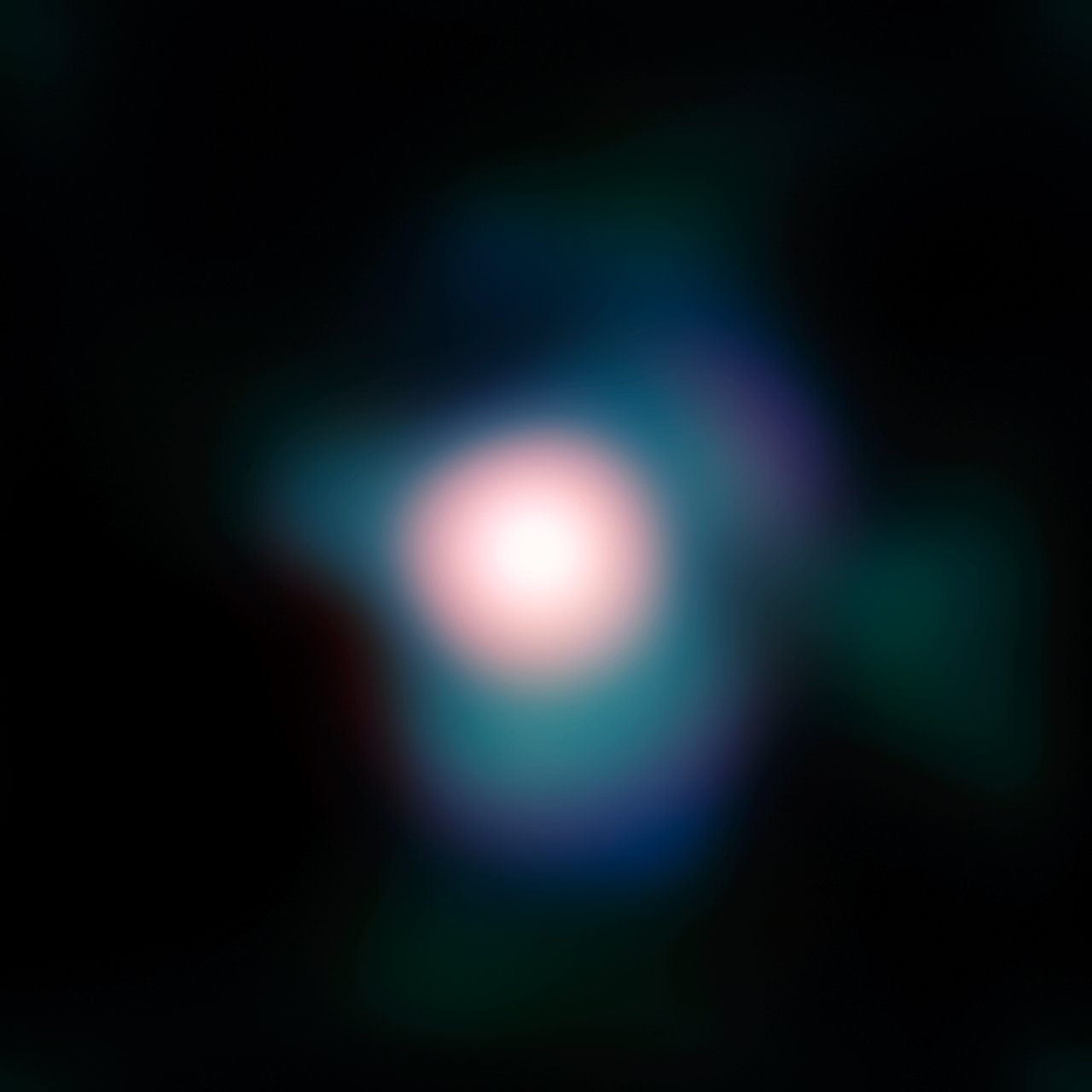
Update: The next image was produced using the ESO's 8m Very Large Telescope with so-called lucky imaging.
Credit: ESO
This is the best ever image of Betelgeuse and its asymetric plume of gas that extends up to six times the diameter of the star. For more information read Closest-Ever Look At Betelgeuse Reveals its Fiery Secret | Universe Today.
Larger and further away than we thought
A 2008 study using the Very Large Array of Radio Telescopes determined that Betelgeuse is further from us than previously thought. This also means that Betelgeuse is proportionally larger than previously thought!
Prior to this Burnham's Celestial Handbook, a standard reference text, gave the distance to Betelgeuse as about 520 light years with a diameter ranging from 550 to 920 solar diameters and a mass of about 20 solar masses. Older sources gave it as 427 light years.
The new distance is calculated as 640 light years (although allowance for error gives a range of 595 to 790 light years). Any variation due to error means that Betelgeuse is larger (or smaller) by the same proportion.
The method used to find the distance to Betelgeuse is called the parallax method and involves measuring the apparent movement of a star from Earth at six month intervals using Earths orbit around the Sun to establish the longest possible base line for triangulation. Astronomers measure such distances in units called Parsecs which are then converted to light years (at 3.26 Light Years / Parsec). This only works for stars that are relatively close to us and depends upon our distance to the Sun.
Astronomers often measure the size of stars in angular diameters as this avoids confusion when a distance is revised. Ignoring the fact that Betelgeuse varies in size and using a typical size (angular diameter) of 0.045" we can see that with this new distance the star is very much larger at 925 versus 750 times the size of our Sun.
To put this in perspective, if Betelgeuse replaced our sun, it would swallow everything out to past Jupiter. Because there is a range and because Betelgeuse is variable and swells, Saturn too might be doomed.
Variable Brightness and Size
Betelgeuse is a variable star that dims and brightens over a period of 5.7 years ranging from magnitude 0.2 to 1.2. There is also a lesser cycle of between 150 and 300 days. Observations of Betelgeuse have shown that this dimming and brightening goes hand in hand with physical shrinking and swelling of the star. Betelgeuse can expand by almost 60% in size!
Stranger still, Betelgeuse appears to be different sizes when looked at with different frequencies of the electromagnetic spectrum! In fact, under some wave lengths it's almost twice as large in diameter as in visible light. The image below from 1998 is just beyond the far infra-red and shows the size of the disk in visible light as well as comparing the size to the orbits of Jupiter and Saturn.
Note: the lines showing the orbits of Jupiter and Saturn are based on the older smaller distance - they are too big! Saturn's orbit should run from +/-50 milliarcseconds.
Betelgeuse's enormous volume vastly overwhelms its high mass and results in a photosphere that is so thin that it has been described as a red hot vacuum. The outer layers of the star may be even more interesting consisting of an extended chromosphere and dust clouds that grow and shrink with the star.
Multiple Stars and Companions?
To my knowledge, the question of Betelgeuse as a multiple star system has not been answered. Articles describing this can be found through the AAVSO (American Association of Variable Star Observers) and even though this isn't in the Wikipedia article there are notes in the accompanying discussion page.
The image below clearly shows four companions labeled B through E (Betelgeuse itself is A). Most of these stars have been known since the time of Herschel.
To give some idea of scale, the distance from Betelgeuse to the E star at 175 arcseconds should be about 0.5 light years based on the latest distance estimates.
It's easy to see that these could be overlooked. Unlike well known binary systems, such as Albireo, these companions are quite dim ranging from 11 to almost 15th magnitude. For comparison, if a duplicate of our Sun orbited Betelgeuse it would appear about as bright as the brightest of these stars. And although several star catalogs list Betelgeuse as a multiple star system, Burnham states that it isn't certain if these are just field stars (or if they form a true multiple star system).
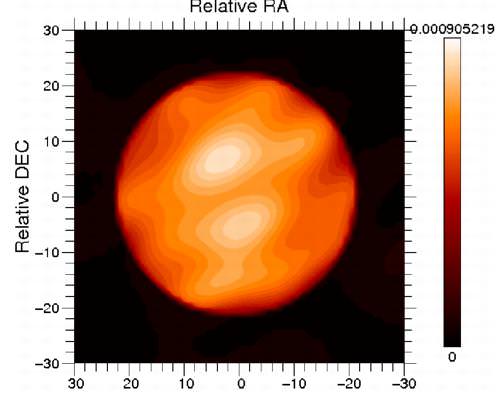
Spots!
Beteleguese is believed to have massive sunspots that have been apparent in images of the disk. Even the first image taken by the Hubble in 1996 showed evidence of a bright region. Recent images obtained from Infrared Optical Telescope Array (IOTA) interferometer on Mount Hopkins in Arizona and the Paris Observatory (LESIA) show two massive spots. The spots are larger than the distance from the Earth to our Sun!
Credit: Copyright 2010 Haubois / Perrin (LESIA, Observatoire de Paris)
Link Universe Today.
Updates:
- The Curious Case of the Shrinking Star | Universe Today - it seems that Betelgeuse has shrunk 15% since 1993.
- Betelgeuse is shrinking: Supernova or Supernothing | Space Disco - about people jumping to conclusions.
- Closest-Ever Look At Betelgeuse Reveals its Fiery Secret | Universe Today - ESO analysis showing giant gas plumes and gas movement across the surface of the star.
- Unprecedented Images Show Betelgeuse Has Sunspots | Universe Today - near infrared inferometry images show massive sunspots.
- Hot Jupiter Trojans! MOST finds exoasteroids?
- MOST caught on camera!
- Planets and Stars - video - Just how big are they?
- Mang gets a space telescope!
- Mang interviewed in Etobicoke Guardian
- Astronomical distances are .... (well) astronomical
- Orion returns to the evening sky
- Breaking news on NEOSSat
- Wikipedia list of brightest stars
- Wikipedia on Betelgeuse
- Making MOST (A scale model made by a Cub Pack)
- Tipsy Orion (when marketing misses the mark)
I'd like to thank Dr. Jaymie Matthews, the Science Team, Ron Wessels, the Operations Team at MSCI (Microsat Systems Canada Inc. formerly the Space Systems division of Dynacon Inc.) for their cooperation and feedback. I'd also like to thank the MOST team, the University of British Columbia, and the Canadian Space Agency for permission to use their images.
Next Article: How You Could Pilot a Space Telescope (Upside Down)
Labels:
Astronomy,
SpaceExploration
Friday, January 2, 2009
Carnival of Space #85 @ Cheap Astro
Check it out here, it's cheap and it's good!
Labels:
CarnivalOfSpace
Subscribe to:
Posts (Atom)


WallyPacholka-750wp.jpg)